






















Your real tree service competitors aren't the companies you think of first. They're the ones Google puts in front of a homeowner who types in a search, and a tree service competitor analysis starts by looking at exactly that screen.
Search your main services in the towns you work in, then write down who holds the top three map listings and the top five organic results. That short list is the field you're playing on, and everything below is about reading it properly.
Which companies are your real competitors?
They're the businesses that appear when a customer in your service area searches for what you do. A rival with a bigger fleet two counties over doesn't matter if it never shows up beside you.
The local SEO competitor guide published by FirstSiteGuide in March 2026 recommends noting the top three map pack results and the top five organic results for your main keywords. Run the search for each service separately. Stump grinding and emergency removal often surface different names than general tree trimming does.
Do it in a private window and from each town you serve, because results shift with the searcher's location. Google itself says distance is one of three local ranking factors, so a company that leads in the next town may be invisible in yours.
How do you audit a competitor's Google Business Profile?
Open each rival's profile and record four things: its categories, its listed services, its photos and what customers say in its reviews. Those fields are what the listing is judged on, and they're all public.
Google describes local ranking as a mix of relevance, distance and prominence. Relevance is how well a profile matches the search, which is why the category choice matters. Check whether a competitor picked a precise primary category and added secondary ones that match services you also sell.
Photos tell you who is actively running the profile. Count how recent they are and whether they show real crews and real jobs.
A profile with old photos and no recent activity is a company that has stopped trying, and that's a gap you can take.
Compare your own profile on the same checklist before you judge anyone else's. If you haven't tightened yours yet, our guide to what to optimize on a tree service Google Business Profile walks through each field.
What do competitor reviews reveal?
Reviews show you what customers praise and what they complain about, in their own words. Read the last twenty or so for each rival and tally the repeats.
The same guide advises looking for repeated praise and repeated complaints rather than judging by the star average. If three different customers say a competitor showed up late, or never sent the promised quote, that's a weakness you can speak to directly in your own marketing by being the company that answers quickly.
Look at how the owner replies, too. Google's advice on replying to reviews is to address the reviewer by name, acknowledge their specific feedback and avoid turning the reply into a promotion. Many businesses ignore this, so a competitor with no replies at all is easy to beat on that front.
One caution on your own side. Google prohibits offering free or discounted work in exchange for posting, changing or removing a review, so a discount-for-a-review scheme is a fast way to lose standing. Ask for reviews with a direct link or QR code instead, which Google explicitly recommends.
Review volume feeds prominence, the third ranking factor. Google states that more reviews and positive ratings can help local ranking, so a rival with a hundred reviews to your twenty has a head start you'll close only by asking every satisfied customer, every time.
How do you check their website and service pages?
Open each competitor's site and look for one thing first: does it have a separate page for each service and each town? The FirstSiteGuide piece says competitors with individual service pages often outrank those that group everything together.
Then look at the basics a homeowner sees in ten seconds. Is the phone number visible, is it clear which towns are covered, and is there a plain way to ask for an estimate? A site that buries these loses leads regardless of how well it ranks.
Read the page titles and headings as well. They show which phrases a competitor is aiming at, and the gaps between their wording and what customers search are where a new page of yours can rank. Our tree service SEO guide covers how to build those pages.
Where are the content gaps?

Photo by Gustavo Fring on Pexels
Skim each rival's blog and social feed and list the topics they cover and the ones they skip. Most tree companies post rarely, so the useful question is what local questions nobody has answered.
Seasonal topics are the obvious opening: storm damage, pruning windows, what to do before the next big wind. We laid out a seasonal marketing calendar for tree service companies you can match against the gaps you find.
Also note how often a competitor posts and whether anyone answers their comments. A feed that was last updated months ago tells you the same thing a stale profile does.
What should a tree service competitor analysis lead to?
Turn the audit into a short list of moves, ranked by how cheaply you can make them. Fix your own profile fields first, then add the missing service and town pages, then start a steady review request routine.
The comparison itself works best as a simple grid, one row per competitor and one column per thing you checked.
| What to check | Where to look | What a gap looks like |
|---|---|---|
| Map position | Search each service in each town | You're missing from the top three |
| Profile categories | Their Business Profile | They list services you sell that your profile omits |
| Reviews | Last twenty or so, plus owner replies | Repeated complaints about speed or quotes |
| Service pages | Their website navigation | One page covers every service, or no town pages |
| Content and posts | Blog and social feeds | Nothing recent, nothing local |
Don't compete on price alone. If a rival is slow to respond, the winning move is speed, and it's cheaper than a discount.
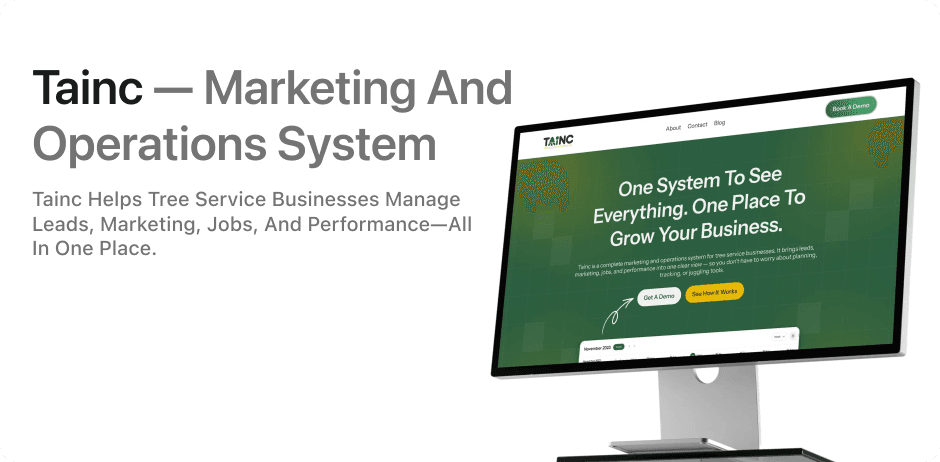
Speed is where tools help. When we built the platform for TAINC, a tree service growth platform, we put lead capture, crew scheduling, AI-assisted proposals and billing into one dashboard, because leads that wait on manual follow-up go to whoever replies first. If you want help turning an audit into a plan, our digital marketing and growth work starts with exactly this kind of review.
How often should you repeat the analysis?
Monthly, and keep it short. The FirstSiteGuide article recommends a quick monthly review because rankings move when new reviews, content and links arrive.
Fifteen minutes is enough: rerun your main searches, check whether the top three changed, and read any new reviews on the companies that moved. Put the findings in the same grid so you can see a pattern over a few months.
End each review by picking one change to make before the next one. A single fix shipped beats a long list that never leaves the spreadsheet.
Frequently asked questions
Do I need paid tools for tree service competitor analysis?
No. Everything in this guide uses public pages: search results, competitor profiles, reviews and websites. Paid rank trackers can save time once you're monitoring many towns, but the first audit needs only a browser.
How many competitors should I analyze?
Start with the companies in the top three map results and top five organic results for your main searches. That is a short list, and it's the one customers are actually choosing from.
Can I copy a competitor's pages?
Don't. Read their pages to see what they cover, then write your own with local detail from your jobs. Copied text doesn't help you stand out, and the point of the analysis is to find what they haven't said.
Should I respond to bad reviews on my own profile?
Yes. Google advises acknowledging any mistakes, apologising where it's appropriate and staying professional, without taking responsibility for things outside your control.
Cover photo by Rafael Minguet Delgado on Pexels
Sources
- How To Do Local SEO Competitor Analysis For Your Business — FirstSiteGuide
- Tips to improve your local ranking on Google — Google Business Profile Help