














A new tree company usually starts with a truck, a crew and a phone that isn't ringing, and the fix is rarely a bigger budget. Effective tree service marketing at this stage is narrow: a few channels set up properly, in an order that puts the cheapest and most trusted ones first.
What follows is that order. It leans on Google's own documentation, the Tree Care Industry Association and a tree-care guide from field-service software maker Jobber, and it says so where the evidence runs thin.
Where tree service marketing starts when you're new
Start by choosing who you want as customers and what makes you the safe choice for them. Jobber's tree service marketing guide, last updated in November 2025, suggests picking an ideal customer, such as homeowners worried about storms or property managers who want regular maintenance, then leaning on a specialty: preservation, fast storm response, spotless cleanup or safe crane work.
Pick one. A new company that claims every kind of work has nothing to point to yet, while one that offers storm cleanup done fast and left tidy gives a homeowner a reason to call. Looking at how established firms in your area describe themselves shows which positions are already crowded, and our guide to competitor analysis for tree service companies walks through how to do that.
The same guide covers brand basics: a distinct company name, a logo that appears on trucks and invoices, clean equipment and an easy way to request a quote online. Most of it is cheap to do early and awkward to change later.
Claim your Google Business Profile first
Local results on Google are mainly based on relevance, distance and prominence, according to Google's Business Profile help page. Relevance comes from how completely your profile describes what you do, distance from where the searcher is, and prominence from things like reviews and links from other websites.
You can't change where a searcher is standing, and Google keeps the details of its ranking confidential. Completeness is the lever you hold. Verify the profile, choose the right business category, fill in your address and hours, and add emergency hours if you take storm calls, as Jobber recommends, along with photos of your crew and your work.
For tree service marketing on a thin budget, this is the first place to spend effort, because the profile appears when someone nearby is already searching for a tree company.
What your website needs to answer
Every channel in tree service marketing ends at your website, and it has to settle one worry fast: is this crew insured and qualified to work above my house? Jobber's list of what belongs on the site is short and practical.
- Your services, described in plain words
- Certifications and insurance details
- Photos of your team and finished work
- Your phone number and address on every page, which Jobber says helps local SEO
- An online booking form or client hub
Jobber also warns against blurry or outdated photos, missing certifications and contact details that are hard to find. A phone number buried in a footer loses the call from someone standing in a yard looking at a fallen limb.
If you'd rather have the site built and connected to your profile and ads, that's part of our digital marketing and growth service.
Reviews: ask after every job
Google says more reviews and positive ratings can help your local ranking, and that helpful replies to reviews help a business stand out. For a company with no history, reviews are also the closest thing to a track record a stranger can read, which makes them one of the first things to get right in tree service marketing.
Make the ask automatic. Jobber suggests sending the link to your Google profile through the invoice, so the request lands right after the customer pays, and replying to the feedback you receive. Our piece on reputation management for tree service companies covers handling the awkward reviews.
Are Local Services Ads worth paying for at the start?
Probably, once your profile and phone handling are ready, because Local Services Ads charge for each valid lead rather than for clicks. Jobber presents them as a cost-efficient way for a new tree company to begin paid advertising.
You set an average weekly budget, and the monthly cap is that figure multiplied by the average number of weeks in a month. Once you hit the cap, the ad stops showing until you raise the budget or the month ends, so a busy stretch can empty the money before the month does.
What counts as a billable lead is broader than most people expect. The table summarises Google's help page.
| Contact | Counts as a lead? | Rule |
|---|---|---|
| Answered call | Yes | Includes calls you return and complete a conversation on |
| Missed call in business hours | Yes | The caller stays on the line more than 20 seconds |
| Caller hangs up at an automated menu | No | The 20-second timer starts at the first key press |
| Repeat contact from the same number or email | No, within 15 days | After 15 days of inactivity, a new contact is a new lead |
| Text, email, voicemail or booking request | Yes | Booking requests are US and Canada only; message leads are usually cheaper than phone leads |
Two things follow. Unanswered calls cost money, so someone has to pick up during the hours listed on your profile. And bad leads can be disputed: Google reassesses charged leads over 30 days, may credit poor-quality or duplicate ones automatically, and takes flags through the feedback survey on the Leads page.
Lead prices vary by location, job type, lead type and bidding mode, and Google publishes no tree-care figure. Treat the first month as a test and write down your cost per lead, which Jobber also recommends tracking, along with how quickly you respond, since it says response speed affects ranking.
Of all the paid tree service marketing options, this is the easiest to audit, because every lead carries a status of Charged, Not charged, In review or Credited.
Referrals, credentials and offline channels

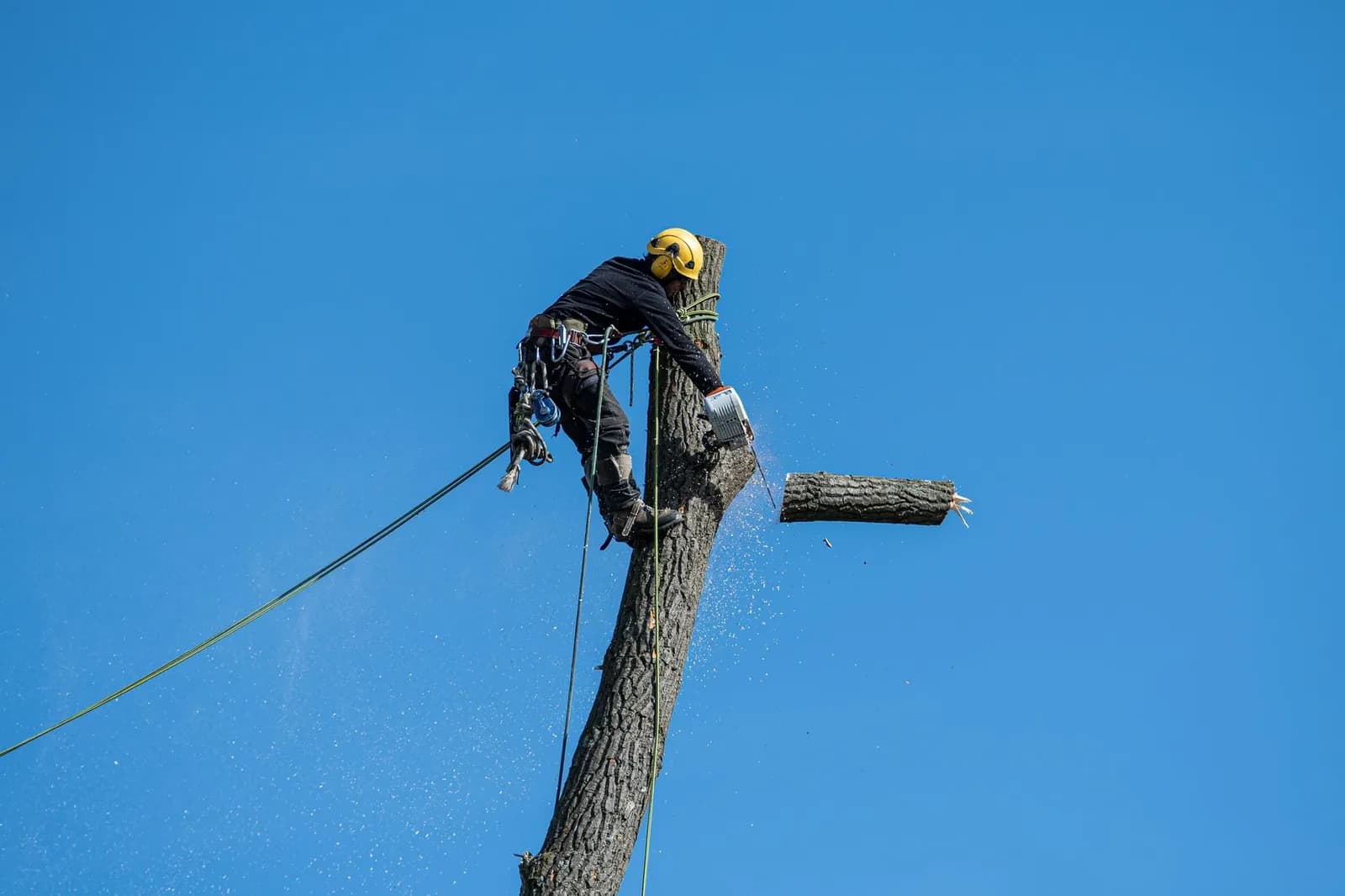
Photo by Gustavo Fring on Pexels
Referrals are worth building a habit around. Jobber's advice is to ask right after a successful job and to get the field crew reminding customers, and it also suggests lead swaps with landscaping companies.
Credentials do some of the selling that a short track record can't. The Tree Care Industry Association runs a third-party accreditation program that reviews a company against industry standards and best business practices, including documented safety and training programs and customer satisfaction practices. Accreditation lasts three years, with yearly checks on staff arborists, insurance and safety and satisfaction ratings, and consumers are told to look for the logo.
A brand-new company won't be accredited in month one. Writing down your safety and training procedures from the start is the groundwork that review looks at.
Offline, Jobber lists lawn signs with your name, phone number and a call to action such as a free tree inspection, plus memberships like TCIA or ISA for credibility. Mailers are a harder call, and we weigh them in direct mail marketing for tree services.
Track where every job came from
Add a "How did you hear about us?" field to every work request, as Jobber suggests, so you can see which channel produced a job and not only a lead. Track cost per lead for Local Services Ads and cost per acquired customer for referrals.
Without that, tree service marketing turns to guesswork by month three, and the channels that feel busiest get the money instead of the ones that book work.
Speed matters here too. A lead waiting on a callback has every reason to call the next company, and our guide to customer follow-up strategies for tree service companies covers the routine.
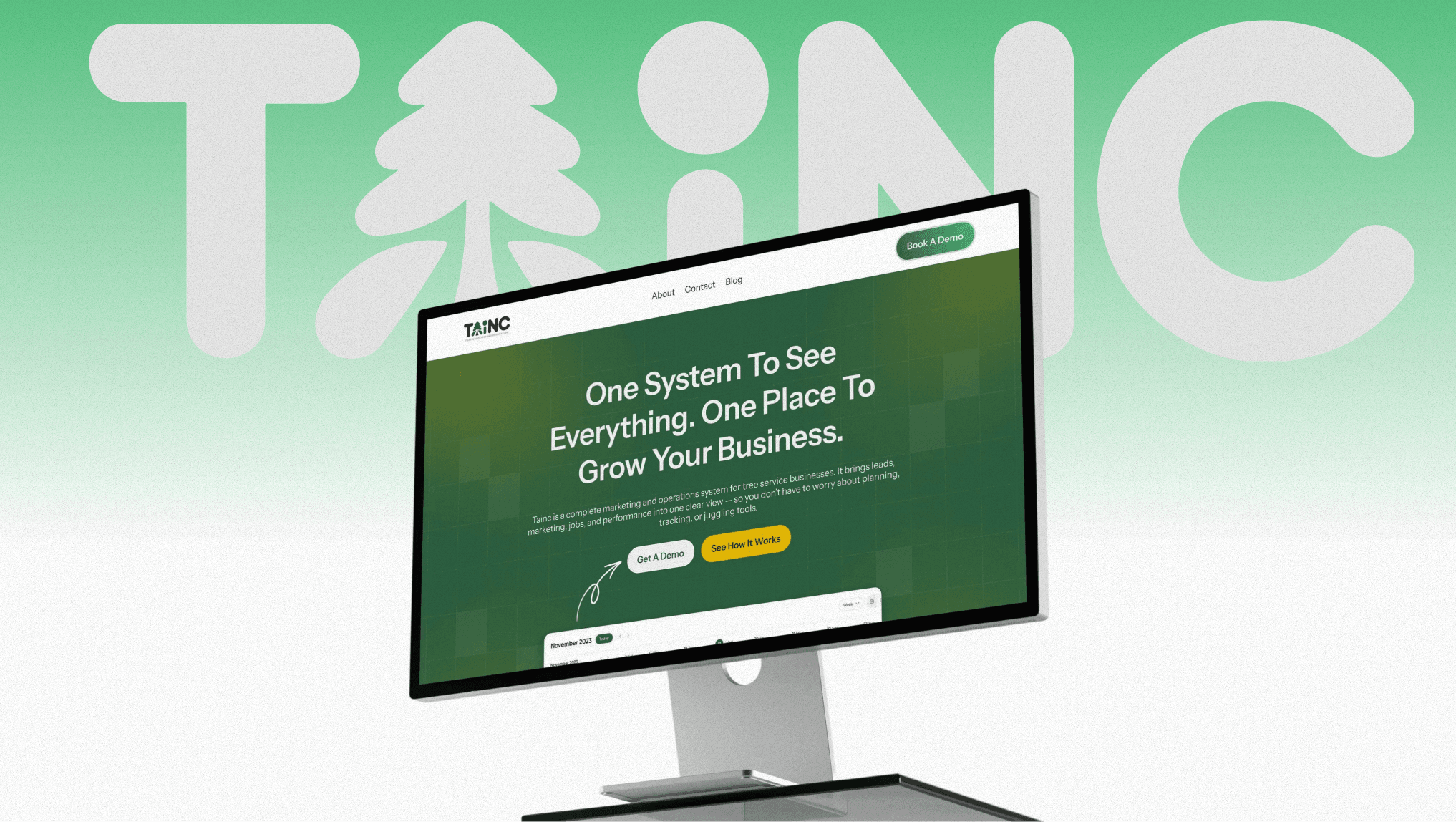
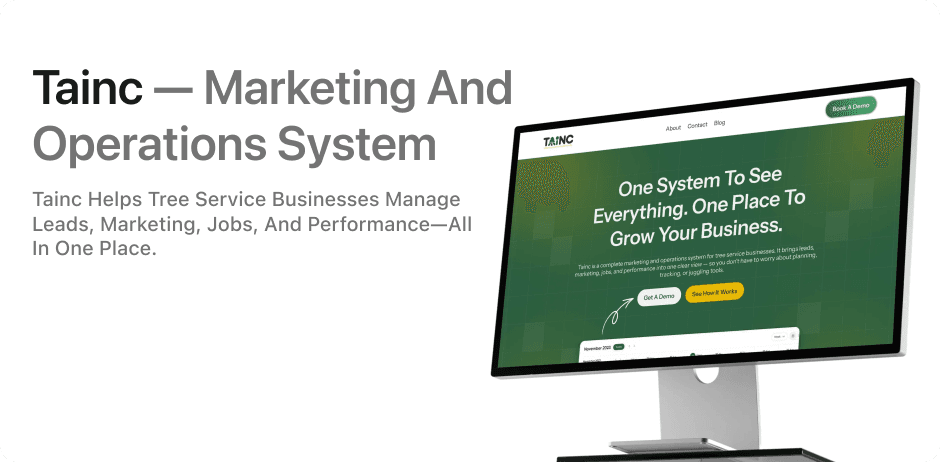
When we built the platform for TAINC (Tree Associate Incorporation), the challenges listed in the TAINC case study included untracked marketing spend and ROI and leads lost to slow manual response. We put lead capture, crew scheduling, AI-assisted proposals and billing into one dashboard.
A sensible order of work
- Pick your customer and specialty, and write it in one sentence.
- Verify and complete your Google Business Profile, with photos and emergency hours.
- Put your services, insurance details, photos and contact details on a website.
- Set up a review request that goes out with every invoice.
- Add Local Services Ads with a small test budget, once someone will answer every call.
- Start a referral habit and the "How did you hear about us?" field, then review the results.
Do the first two before spending anything. Every paid lead lands on that profile and that site, and a weak one wastes the click or the call you just paid for.
Frequently asked questions
Can I pay to rank higher on Google Maps?
No. Google states there is no way to request or pay for a better local ranking. Paid visibility comes from ads such as Local Services Ads, which are separate from your profile's ranking.
Can a new company apply for TCIA accreditation?
Any commercial tree care company in the United States or Canada can apply, and TCIA lets companies contact it to pre-qualify before enrolling. The review looks at documented safety and training programs, so a young company should expect to have that paperwork ready.
How much should a referral reward be?
Jobber's examples are a $50 discount on the customer's next service or $50 cash per closed referral. Those are one company's suggestions, not a measured norm, so start there and adjust to your job sizes.