




















Nobody outside the marketing industry has published a reliable percentage of revenue for a tree service marketing budget, and the numbers vendors quote contradict each other. The one budget figure we could trace to a neutral publisher is 7.7% of company revenue, and it describes corporate marketing departments rather than a ten-person tree crew.
So the useful question changes. Instead of asking what percentage to spend, work out how many jobs you need, what each one costs to win, and how much of every sale is left as profit.
What a tree service marketing budget should look like
There's no sourced rule for tree companies specifically, so treat any flat percentage you read as a guess. The closest neutral reference is Gartner's 2025 CMO survey, which Marketing Brew reported as flat at 7.7% of revenue, drawn from about 400 marketing leaders in North America, the UK and Europe, most at companies earning over $1 billion a year.
That tells you what large brands spend. It says nothing about what a regional arborist needs, because a company that already has a name in its market and a company building one from zero don't face the same job.
Our view: use a percentage only as a sanity check after you've built the number from jobs, as the next sections do.
Work backward from the jobs you want
Start with how many extra jobs you want each month, then divide by your closing rate. That gives the number of estimates your marketing has to produce.
In a 2018 post on the Arbtalk forum, accountant and arborist Ed Morrow worked through a closing rate of 12 jobs won from 25 assessed, or 48%. At that rate, ten extra jobs a month needs about 21 estimates. That's our arithmetic on his example, not a benchmark.
Each estimate starts as a lead, and some leads never become estimates. No source we read gives a typical lead-to-estimate rate for tree work, so measure yours over a quarter before you commit a larger budget.
Multiply the leads you need by what a lead costs you, and your tree service marketing budget has a reason behind it.
What a marketing dollar should return
Morrow's rule of thumb is that every £1 spent on marketing should bring in at least £5 of revenue, so £500 should aim at £2,500. He wrote for a UK audience in pounds, but the ratio travels.
Revenue isn't what pays you, though. Morrow also says gross margin should typically be at least 30%. At that margin, £5 of revenue leaves £1.50 of gross profit against £1 of marketing, which is thin once overheads are counted.
If your margin sits nearer his 50% example, the same £5 leaves £2.50. Your own margin, more than any industry percentage, decides how much room the budget has.
Budgeting for Local Services Ads without overspending
Within any tree service marketing budget, Local Services Ads are the easiest paid channel to put a ceiling on, because Google charges per valid lead and lets you cap the spend. They also make the arithmetic above concrete.
How the weekly budget and monthly cap work
You set an average weekly budget. Google's lead documentation says a week can run over that figure, but the month can't: the cap is your weekly budget multiplied by the average number of weeks in a month, and once you hit it the ad stops showing until the next month.
The same page lists what counts as a charged lead: answered calls, missed calls where the caller stays on for more than 20 seconds, text or email messages, voicemails, and booking requests in the US and Canada. A repeat contact from the same number or email within 15 days isn't charged again.
Charged leads are reassessed for 30 days, and a lead judged low quality, duplicate or invalid is credited automatically. A call you ignore can still cost you, so answer it.
Why Google suggests ten leads a week
Google's bidding guide recommends a budget that supports at least 10 leads per week, and says results take about two weeks to settle while the system learns your business. It offers three bid modes: Maximize leads, Target cost per lead and Max per lead.
It gives no dollar figures. Prices depend on location, job type, lead type and bidding mode, so the minimum weekly budget is ten times a number only your own account will reveal.
Plan a first month as a price-discovery exercise, and don't judge the channel on week one.
Tracking spend to booked jobs

A budget you can't trace to jobs is a donation. The cheapest tracking method in the sources is also the oldest: Morrow says to ask every new client how they heard about you, so you can see which channels bring work.
Three numbers, kept in a plain spreadsheet, are enough to run a tree service marketing budget:
- Return on marketing: revenue from each channel against what you spent on it.
- Closing rate: jobs won divided by estimates given. A low rate can mean you're over-bidding or not explaining your value, according to Morrow.
- Gross profit per job, so a cheap lead for an unprofitable job doesn't look like a win.
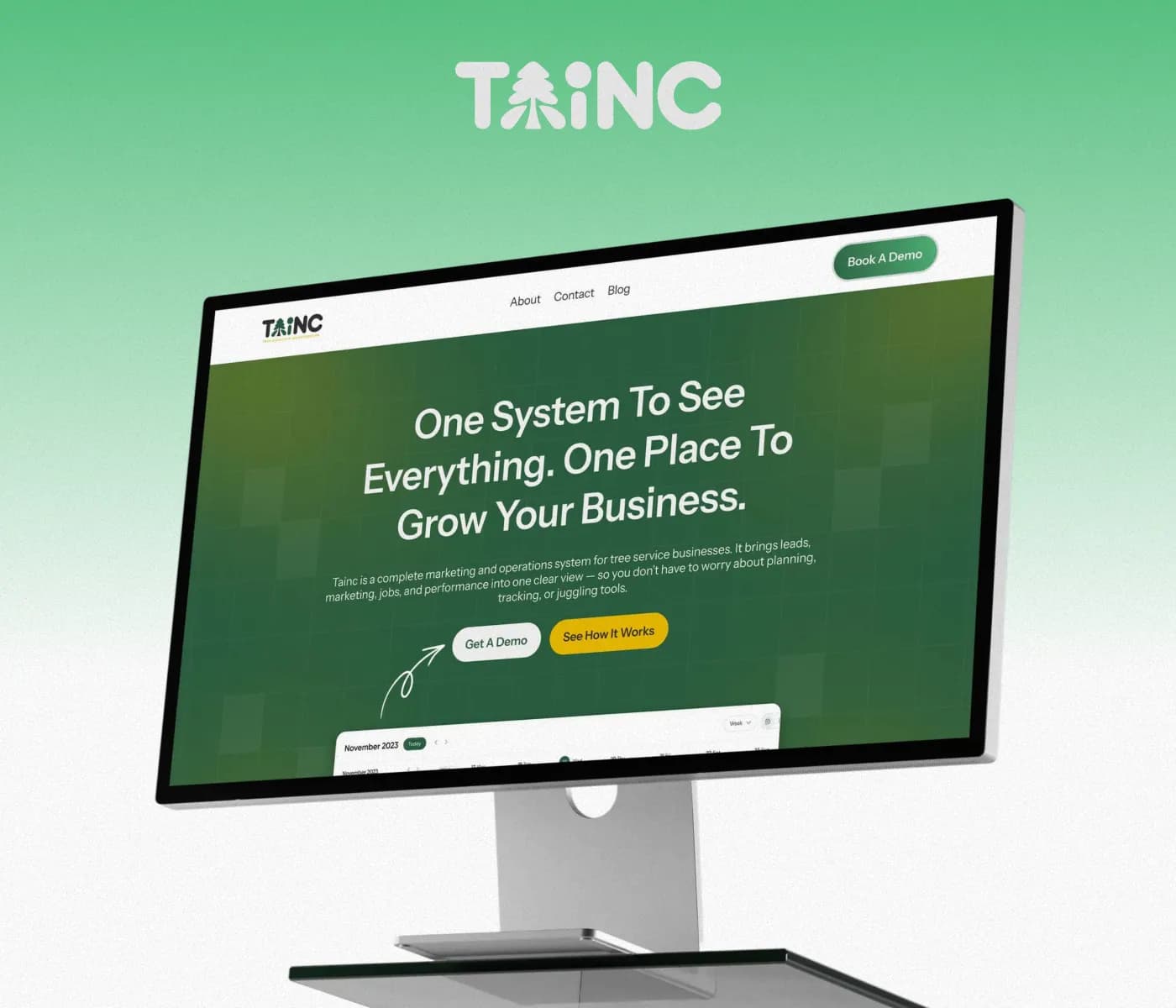
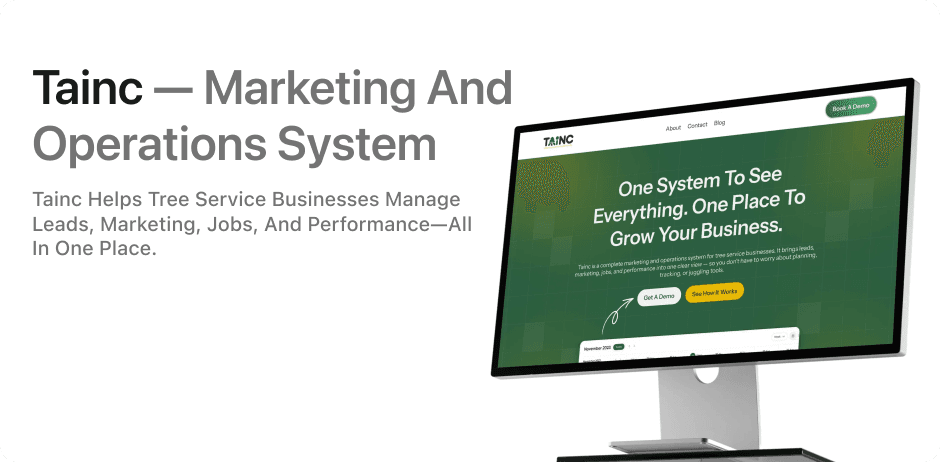
When we built TAINC's all-in-one platform for tree service companies, it combined lead capture, crew scheduling, AI-assisted proposals and billing in one dashboard. You don't need software to start, but the principle holds: leads, estimates and invoices belong in one place.
Where the first dollars should go
Ad spend stops working the moment you stop paying, since a Local Services ad disappears when the cap is reached. Work on your own pages keeps standing after the budget runs out.
For a company with little online presence, that argues for fixing the free and slow-burning pieces first. Our guides cover what to optimize on a tree service Google Business Profile and how to rank in your own area, and the broader tree service SEO guide shows what moves rankings.
If you're weighing an outside provider for that work, our SEO pricing breakdown explains what the fees buy. For a wider menu of channels, marketing ideas that bring in jobs is the place to start.
Our digital marketing and growth work covers this ground for service businesses. Whoever does it, build the tree service marketing budget the way this post does: from jobs, closing rate and margin, with a review each quarter against what the tracking shows.
Frequently asked questions
Does Google charge for every call from Local Services Ads?
No. Google says it charges only for valid leads, assessed when the customer first makes contact. Invalid or low-quality leads aren't charged, and ones that slip through can be credited within 30 days.
Is the monthly cap the same as my weekly budget times four?
Not exactly. Google defines the monthly maximum as your average weekly budget multiplied by the average number of weeks in a month, and your spend in any single week can go above the weekly figure.
How do I know which part of my tree service marketing budget is working?
Ask every new client how they found you and record the answer against the job's revenue. Compare each channel's return with the £5 for every £1 benchmark Morrow suggests, adjusting for your own margin.
Sources
- Marketing budgets, Gartner CMO report — Marketing Brew
- 30 metrics to help your tree care company — Arbtalk