

















A tree service company that starts running Google Ads without picking a lane first usually ends up paying for the click and the lead, with no clean read on which one did the work.
Google actually sells two different products under that heading: Local Services Ads, which bill per lead, and standard Search campaigns, which bill per click whether or not the visitor ever calls.
The tree service Google Ads decision that matters most isn't the headline or the offer. It's which of these two you run first, because the eligibility, the billing and the control you get over who sees the ad are almost nothing alike.
Google Ads for Tree Service Companies: Local Services or Search?
Local Services Ads sit above the regular search results and above standard Search ads too, showing a green checkmark badge, a star rating and a phone number.
Google's own Local Services Ads page puts the pitch plainly: you only pay when a potential customer actually gets in touch through the ad, not for every click on it.
Search Ads work the way most people picture Google Ads working. You bid on keywords such as "tree removal" or "stump grinding," and you're charged per click whether that visitor calls, browses two pages and leaves, or was never going to hire anyone.
| What you're comparing | Local Services Ads | Search Ads |
|---|---|---|
| What triggers a charge | A valid lead: a call, message or booking request | A click, regardless of what happens after |
| Screening to get in | Background check, license and insurance review | None; open an account and set a budget |
| Where it appears | Above search results and above Search ads | Above organic results, below Local Services Ads |
| Control over targeting | Google matches leads within your job types and area | You choose keywords, match types and bids |
That last row is the real trade-off. Local Services Ads hand Google the wheel on which searches you show up for. Search Ads hand it to you, for better or worse.
Neither product changes where you sit in the organic map listings just below both of them. Ranking locally without paying for every click takes a different kind of work entirely.
How Local Services Ads billing actually works
You're charged for each valid lead, and Google spells out exactly what counts in its guide to how leads are billed.
- Answered calls where the customer actually talks to you
- Text messages or emails a customer sends through the ad
- Voicemails and booking requests
- Missed calls, once you return them
Leads that fall outside your business hours, that are pure price research, or that ask for a service you don't offer aren't chargeable. You don't set a per-click bid here.
Instead you set an average weekly budget based on how many leads you want in a typical week. Google can spend above that in a single week, as long as the month stays under the weekly figure multiplied out.
A lead gets assessed the moment the customer makes contact. Google's models keep reassessing it afterward, and can issue automatic credits if a charged lead turns out to be low quality.
Getting through Google's screening before you can run it
This is where a lot of tree service owners get stuck. Google's screening and verification requirements call for a background check on the business, on the owner, and on the field workers who'll actually show up at a customer's property.
That's on top of confirming applicable state or local licenses and checking that the business carries the right insurance. None of it is optional, and none of it happens fast.
A business that can't produce clean documentation on any of the three doesn't get the Google Guaranteed badge and doesn't run the ads at all. Start the paperwork before you plan a campaign around it, not after.
Building a Search Ads campaign without wasting the budget

Picking keyword match types
Every keyword in Search Ads gets one of three match types, and the type decides how loosely Google interprets it. Broad match is the default, and it can show your ad on searches that don't share the direct meaning of the keyword at all.
Phrase match, written in quotes, only shows for searches carrying your keyword's actual meaning. Exact match, in brackets, is the tightest of the three.
For a tree service, that spread matters more than it sounds. A broad match on "tree removal" can pull in someone searching for tree removal jobs to apply for, not tree removal to hire.
Phrase or exact match keeps the spend closer to people who actually want a crew at their address.
Google's guidance on keyword matching leans the other way for advertisers using Smart Bidding, recommending broad match paired with automated bidding so its AI can find valuable searches a narrower match would miss.
Which one wins depends on how much you trust the algorithm to sort intent for you, and how much budget you can afford to lose while it learns.
Setting your budget and bid strategy
Your average daily budget is exactly that: an average, not a ceiling. Google can spend up to twice that amount on a single strong day.
The pattern evens out so your monthly total never exceeds roughly 30.4 times the daily figure. Miss that pattern and a slow Tuesday can look like Google overcharged you, when it's actually making room for a busier Thursday.
Two bidding approaches cover most tree service accounts starting out. Maximize Clicks lets Google's automated bidding chase as many clicks as your budget allows.
Manual CPC puts you in charge of the ceiling on every keyword. That's slower to manage, but it keeps one expensive term from eating the week's budget on its own.
Which one should a tree service run first
Start with Local Services Ads if you're choosing one. The screening is the annoying part up front, but it's also what earns the badge sitting above every other listing, and you're not paying for a click from someone who was never going to call.
Add Search Ads once you know which job types and neighborhoods actually convert. Use it to cover the searches Local Services Ads doesn't reach, or the crew capacity you want to fill in a specific week.
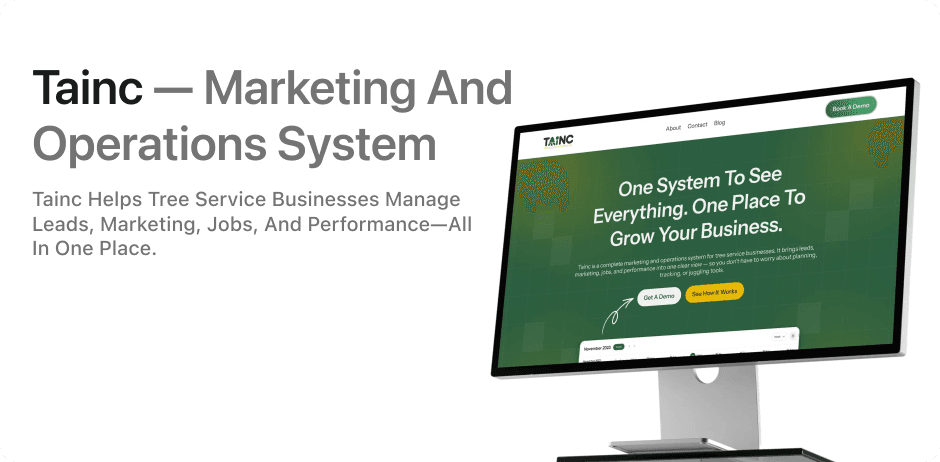
Winning either format still comes down to what happens after the phone rings. When we built TAINC's platform, a tree service company, we combined lead capture, crew scheduling and billing into one dashboard specifically because leads were sitting unanswered while jobs moved to whoever picked up first.
A lead you paid sixty dollars or six hundred for is worth nothing if it waits four hours for a callback. That's exactly the gap covered in what actually gets the phone to ring once the ad has done its job.
Getting your ads and marketing strategy right buys you the lead. What you build behind it decides whether it turns into a job.
Frequently asked questions
How long does Local Services Ads approval take?
Google's screening process runs three to four weeks after you submit your documents, so start the background check, license and insurance paperwork well before you want the ads live, not the week you plan to launch.
Does a missed call count as a paid lead?
Yes, if you return it. Google counts a missed call as a valid, chargeable lead once you call, text or email the customer back, so ignoring it doesn't avoid the charge and it does cost you the job.
What happens if a lead turns out to be spam or a wrong number?
Google assesses a lead the moment the customer makes contact and won't charge for one that's clearly invalid. Charged leads get reassessed afterward too, and Google can issue an automatic credit if one turns out to be low quality.
Cover photo by Rodolfo Gaion on Pexels
Sources
- How leads work — Google Local Services Help
- Business screening and verification requirements - United States — Google Local Services Help