




















Miller's Tree Service in Tallahassee needed about five months before its whole office was working inside SingleOps, and for much of that time the sales team and crew leaders argued over how much detail belonged in a work order. According to TCI Magazine's report on three tree companies' CRM rollouts, that friction is normal. Tree service CRM setup is mostly a people problem with a software problem attached.
This guide covers what the system has to hold, the order to build it in, what the common tools cost, and where owners lose months.
What a tree service CRM actually has to hold
A CRM for a tree company stores every customer, every property they own, every quote you sent and every conversation along the way, in one place that the office and the crews can both open. A shared calendar and a spreadsheet can do part of that. They stop working once the same job touches sales, scheduling and billing.
Look at how one tree-care vendor describes the contact record. Arborgold lists more than 35 contact fields, unlimited job sites per customer and tagging by lead source and category. The job-site detail matters for tree work, where one customer can own a front yard oak, a back lot of pines and a rental property across town.
Lead source is the field owners skip and regret. Without it, you can't tell whether the money you spend on Google, a mailer or a truck wrap produces jobs.
How to approach tree service CRM setup step by step
Build the system in the order work flows through your business: a lead arrives, someone quotes it, a crew does it, you bill it. Setting up features in a different order is how companies end up with a tool half the office ignores.
Load your existing customers first
Gather past customers from wherever they live now: QuickBooks, a phone, a notebook, an email inbox. Clean the duplicates before you import, because a CRM full of two entries per customer teaches your staff not to trust it on day one.
At Miller's, the first technical step was linking the CRM to QuickBooks and customising the files. After that, the system kept customer information on hand for repeat work, so staff could pull up how a previous job was done, notes included.
Define the pipeline stages
A pipeline is the list of stages a lead moves through. Keep it short and name the stages after real events: new inquiry, estimate scheduled, quote sent, quote accepted, job scheduled, invoiced. Each stage should have one person responsible for moving it forward.
If you can't say who owns "quote sent", quotes will sit there for weeks. Your best leads are in that column.
Set up scheduling by crew
Miller's set up calendars by crew, having outgrown the shared Google Calendar it started with. Do the same from the start. A calendar per crew shows which team is overbooked before you promise a homeowner Thursday.
Add follow-up and write down the process
A quote that gets no reply should trigger a reminder to call, and an unanswered web inquiry should alert someone the same day. Automations like these are where a CRM earns its cost, and they only work if the stages above are accurate.
David's Tree Service in Huntington Beach, which has been operating since 1981, wrote standard operating procedures and built slide decks to train its team. Its CEO still described the first months as hard for owners, managers and employees alike.
What CRMs for tree companies cost
Prices run from under $30 a month for a solo operator to several hundred for a crew with multiple office users, and most vendors charge extra per additional user. Jobber's published plans show how the steps up work, using its prepaid annual rates with one user included.
| Jobber plan | Price per month, billed annually | What the step up buys |
|---|---|---|
| Core | $29 | Job basics, invoicing, online payments |
| Connect | $99 | Automation, expense tracking, SMS messaging |
| Grow | $149 | Job costing, advanced quotes, workflow automation |
| Plus | $399 | Crew scheduling, pipeline, AI Receptionist, marketing suite, 5 users |
Those figures come from Jobber's pricing page, which also lists additional users at $29 each and a 14-day free trial of the Grow plan with no credit card. Arborgold, built specifically for tree, lawn and landscape companies, says its plans start at $119 a month.
Notice that crew scheduling and a real pipeline sit in the top tier of that table. If you run more than one crew, the cheap plan will be missing the features you most need, so price the plan you'll actually use rather than the one on the front of the page.
Run the trial with real jobs. Enter ten of last month's quotes and see whether the system matches how your office works.
Why adoption takes months and what shortens it
Owners tend to budget a weekend for setup and then find the real work is behaviour change. Miller's operations manager Tim Walters told TCI Magazine that if he had stopped and said "let's go back," he would have received zero pushback, because nobody likes change. He kept going, and the company eventually reported that everyone had bought in.
David's Tree Service spent three to four months preparing before launch and about a year reaching proficiency. Its CEO, Darren Diaz, later said the company underestimated how complex the program would be to build and roll out. The payoff he reported was a 15% increase in closing rates.
His advice was blunt: hire a consultant, because the process goes faster and skips many of the mistakes his team made. Kurt Stenberg of Cochrane Tree Care, a sole proprietor in Alberta, took the other route, learning Jobber on his own with the vendor's support services, and found the learning curve manageable for a one-person operation.
The split is by size. One person can learn a simple tool alone, while a company with a sales team, an office and several crew leaders is changing how five or six people work, and that deserves a person whose job it is to lead it.
When one dashboard beats a stack of separate tools

Photo by Egor Komarov on Pexels
Most tree companies end up with a CRM, a quoting app, a payments tool and a calendar, and spend part of every week reconciling them. David's Tree Service ran into this and eventually integrated its CRM with HubSpot to remove the manual double entry between the two systems.
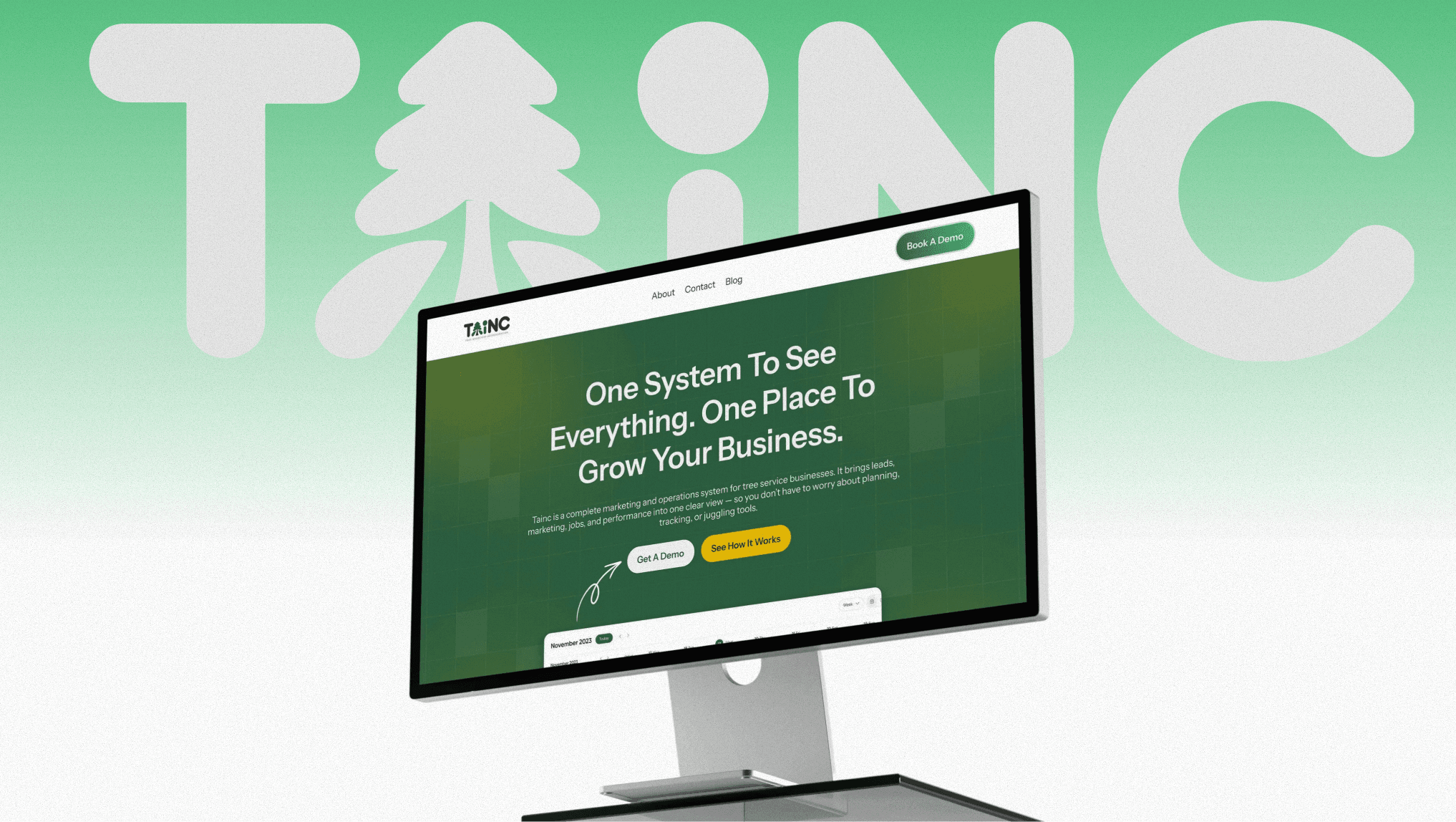
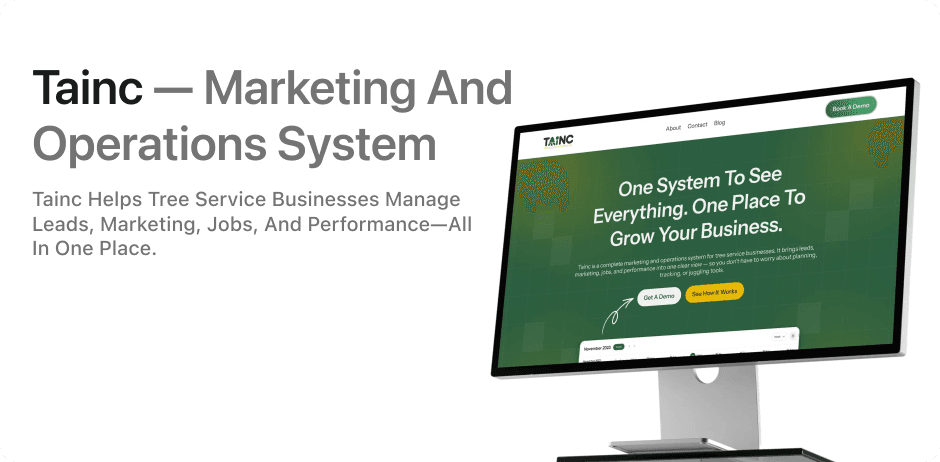
Some companies would rather not stitch tools together at all. When we built TAINC's all-in-one growth platform for tree service businesses, we put lead capture, crew scheduling, AI-assisted proposals and billing into a single dashboard, with role-based access for admins, teams and users. It was designed to replace multiple tools and to give live visibility into leads and crews.
If your quoting or follow-up process doesn't fit any off-the-shelf product, custom AI and automation work is the alternative to bending your process around somebody else's software.
Feeding the CRM with leads you can trace
A CRM only helps if leads reach it, and for most tree companies those leads come from search. Your Google Business Profile and local SEO work decide how many calls and web forms arrive, and the CRM tells you which of them turned into paid jobs.
Seasonality changes what you should expect from each source. Storm work, pruning season and slow winter months all produce different lead mixes, which the seasonal marketing calendar for tree service companies lays out month by month.
So tag every lead with its source from the first day. Three months later you'll know which channel to spend more on, and that report is worth more than any feature on the pricing page.
Frequently asked questions
Can a tree service CRM connect to QuickBooks?
Yes. Miller's Tree Service linked its CRM to QuickBooks as part of the initial setup. Check that your shortlisted tool supports the accounting software you already use before you commit.
Is there a free trial?
It depends on the vendor. Jobber offers 14 days with full access to its Grow plan and no credit card required. Test with real quotes during the trial period.
Do I need a consultant to set up a CRM?
A consultant helped David's Tree Service avoid mistakes, and its CEO recommends hiring one. A sole operator like Kurt Stenberg set up Jobber alone using the vendor's support. The more people who use the system, the more a guide is worth.
Can a CRM work alongside HubSpot?
It can. David's Tree Service integrated ArborNote with HubSpot to avoid entering the same details twice.
Cover photo by Jimmy Chan on Pexels
Sources
- Adapting to CRM pays off, but it takes time — TCI Magazine
- Jobber pricing — Jobber