












A prototype of a clinical tool can be built for under US$30 with plain-language AI tools, according to a November 2025 Healthy Debate opinion piece by a health sciences student and a resident physician. That price explains the appeal of a vibe coding healthcare app. It also hides where the real cost sits: everything that happens once actual patient data arrives.
The short answer is that vibe coding suits healthcare prototypes and low-risk internal tools, and it stops suiting you the moment protected health information (PHI) enters the app. What follows shows where that line sits, what crosses it, and how to build past it.
What a vibe coding healthcare app is good for
It's good for testing an idea before anyone commits a budget. The same Healthy Debate authors point to prednisone taper calculators, procedural annotation tools, decision-support checklists and teaching simulators as the sort of thing clinicians have already built this way.
Traditional custom software, they write, can run to tens or hundreds of thousands of dollars. Against that, a throwaway prototype that shows colleagues what a workflow could look like is cheap, fast and easy to discard.
That's the honest use case: find out whether the idea is worth building properly. If you want the broader picture first, our explainer on what vibe coding is and how it speeds up an MVP covers the mechanics, and rapid prototyping with AI shows how a prototype gets from idea to something testable.
The same authors are blunt about the limit. Their position is that vibe-coded tools should never handle personal health information, because even a local application can store sensitive data insecurely. A reader commenting on the piece added that AI-generated code often contains errors that take health informatics expertise to spot.
Why patient data changes everything
Once a vibe coding healthcare app touches PHI, HIPAA obligations apply to the organisation running it, and the AI tool that wrote the code doesn't take any of them on. HIPAA Insider, published by the hosting vendor HIPAA Vault in August 2026, says plainly that AI can cut build time and cost but does not transfer HIPAA responsibility away from the healthcare organisation.
That article lists four checks to run before an AI-built app goes near PHI:
- Keep PHI out of prototypes and prompts. Use synthetic or properly de-identified test data unless a service is approved for PHI under your agreement and configuration.
- Map every vendor and data flow: hosting, email, SMS, APIs, databases, logging and analytics, not just the screens people see.
- Remove secrets from the code, rotate credentials where needed, and keep them in a proper secrets-management system.
- Test the security controls. Authentication says who a user is; authorization decides which records that user may open. Both need testing, not trust.
The second check is the one vibe-coded apps fail quietly. An AI builder picks a database, a logging service and an analytics tool because they work, not because anyone signed a business associate agreement with them. Every one of those is a vendor you now have to account for.
The article also says a vendor that handles PHI may need a business associate agreement, and you have to confirm one is actually available before the data flows. If it isn't, the tool stays in the prototype pile.
How secure is AI-written code?
Not secure enough to ship unreviewed. In a 2025 report, the security vendor Veracode ran 80 code-completion tasks across more than 100 language models and found that the generated code introduced vulnerabilities in 45 percent of cases.
Read that number for what it is. It describes a set of test tasks scanned with Veracode's own static analysis, and Veracode sells security products, so it's a vendor's measurement and not a rate for every app ever generated. Still, the company also reported that newer and larger models were no better at security, even as the code they wrote got more likely to run.
For a vibe coding healthcare app the practical reading is simple. Working code is not safe code, and the gap shows up in exactly the places a patient portal can't afford: login, record access and anything that logs user input. A human with security experience has to review that code before real records go near it.
When does the app count as a medical device?

It depends on what the software does, and you should settle the question before you build, not after. The FDA's final Clinical Decision Support Software guidance, dated January 2026, explains that the 21st Century Cures Act excludes certain decision support software from the definition of a device, provided it meets the Non-Device CDS criteria.
Software that doesn't meet those criteria stays subject to FDA digital health policies, and the guidance says this includes functions intended for patients or caregivers. A symptom checker aimed at the public and a checklist aimed at clinicians aren't treated the same way.
The guidance itself holds the criteria and the worked examples, so read it, or have your regulatory adviser read it, against your feature list. Nothing about how the code was written changes the answer.
Healthy Debate raises a related point for Canada: Health Canada rules and organisational IT policies may limit vibe coding to low-risk, non-PHI uses unless governance changes. Wherever you operate, check the local rules before the prototype turns into a product.
Prototype first, then build it properly
Our recommendation for any vibe coding healthcare app is to split the project in two. Use vibe coding to test the idea with synthetic data, show it to the clinicians and patients who'd use it, and decide whether it deserves a real budget. Then rebuild the parts that matter on an architecture designed for PHI from day one.
That second step is ordinary engineering work: access control per role, audit trails, a signed agreement with every vendor in the data flow, and a security review before launch. Our comparison of vibe coding versus traditional development goes deeper on where each approach earns its keep, and no-code versus vibe coding explains why the two aren't interchangeable.
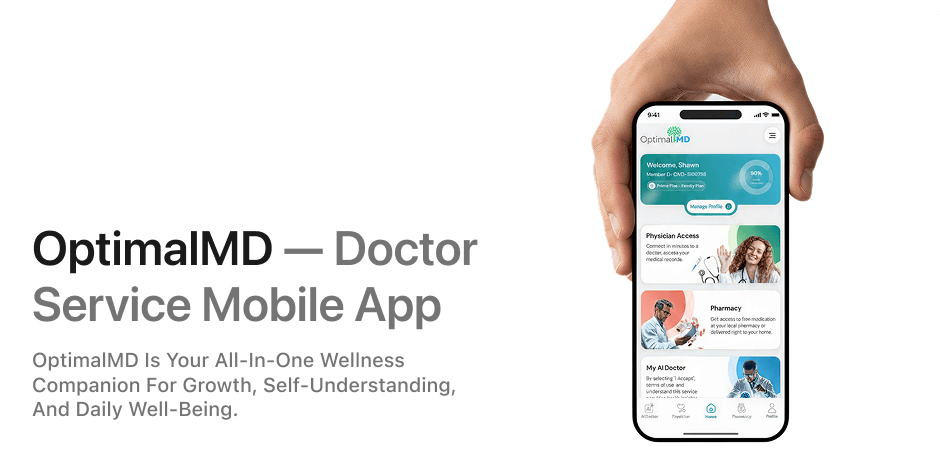
When we built OptimalMD's digital product, we handled it end to end, from design through development to launch: the website, the members portal and the mobile app. Our apps and SaaS team takes on the same kind of work for clinics and health startups that have outgrown a prototype.
Before any of that, map the patient journey. A prototype that automates the wrong step is still the wrong product, and patient journey mapping is the cheapest way to find out which step that is.
Frequently asked questions
Can a vibe coding healthcare app be HIPAA compliant?
Only if the whole system around it is. The code generator doesn't decide that; the vendor agreements, hosting, access controls and risk analysis do. Per HIPAA Insider, AI doesn't shift HIPAA responsibility away from the healthcare organisation.
Is it safe to paste patient data into an AI app builder?
No. Use synthetic or properly de-identified data in prototypes and prompts, unless a service is approved for PHI under your agreement and configuration.
Can clinicians build their own tools this way?
For low-risk, non-PHI tools, the Healthy Debate authors argue yes, under IT oversight and treated as pilots. They also warn that clinicians may lack the expertise to catch subtle errors or keep a tool reliable over time.
Does a vibe-coded clinical app need FDA review?
It depends on its function, not on how it was built. The FDA's CDS guidance sets out which decision support functions are excluded from the device definition, and software outside that exclusion remains subject to FDA digital health policies.
Cover photo by erwinbosman on Pixabay
Sources
- The software we deserve: Vibe coding the future of health technology — Healthy Debate
- Four checks before your AI-built app handles PHI — HIPAA Insider