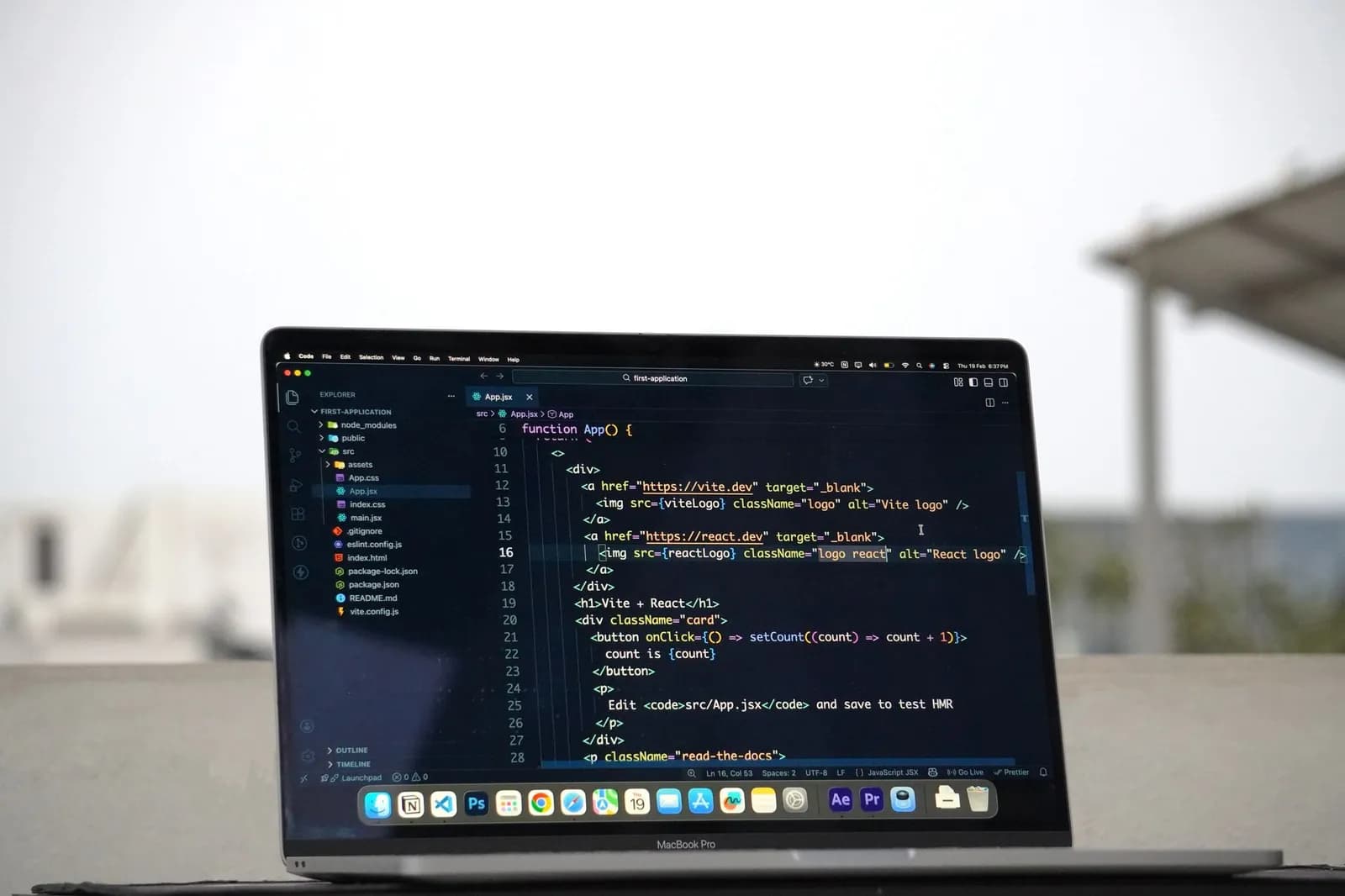
Collins Dictionary defines vibe coding as "the use of artificial intelligence prompted by natural language to assist with the writing of computer code", and Business Insider reported that Collins made it its 2025 word of the year. No-code is older and sounds similar, which is why the two get lumped together. In practice, no-code vs vibe coding is a choice between two different things you end up holding when the build is done.
With no-code you hold a project that lives inside someone else's platform. With vibe coding you hold a pile of source code that an AI wrote and that you may or may not be able to read.
No-code vs vibe coding: where the real difference sits
No-code means building an app by arranging visual components in a drag-and-drop editor. Vibe coding means describing what you want in plain language and letting an AI model generate the underlying source code. Everything else follows from that split.
The term comes from Andrej Karpathy, who wrote in a February 2025 post on X that you "fully give in to the vibes, embrace exponentials, and forget that the code even exists." That's the loose version this article means: prompt, accept, run, repeat.
If you want the longer story of the term and how it plays out for founders, we cover it in our explainer on vibe coding and MVPs.
The two approaches compared on the same criteria
The table below draws on the guides from Bubble, a no-code platform, and Wix, which sells products in both categories. Both have a stake in how the comparison reads, so weigh the framing accordingly. Their descriptions of how each approach works agree with each other.
| Criterion | No-code | Vibe coding |
|---|---|---|
| What you build with | Pre-built visual components in a platform's editor | Plain-language prompts that produce source code |
| Who can read the logic | Workflows show up visually, so non-technical team members can follow them | Someone who can read the generated code |
| Hosting and database | Typically included in the platform | Separate infrastructure you set up and manage |
| Pricing pattern | Predictable subscription | Often usage-based, charged per AI generation |
| Where it hits limits | The features and integrations the platform supports | Structural problems that accumulate in generated code |
Each approach is strongest exactly where the other is weak, and that's the whole comparison.
What you own when the project is finished
Vibe coding gives you real source code, which you can move, extend and hand to a developer. No-code gives you an app that runs on the platform and, in the usual case, stays there.
That difference matters most once a project outgrows its first version. A platform's boundaries become your boundaries: a custom data model, an unusual permission rule or an integration the vendor hasn't built is something you wait for rather than do. Wix describes no-code flexibility as "broad but bounded by the platform's components".
Vibe coding avoids that ceiling and meets another. Wix warns that it "can produce a codebase that works but that nobody fully understands". A working app nobody can explain is cheap to start and expensive to change, because whoever modifies it first has to work out what it does.
Is vibe-coded software secure?
Not by default, and bigger models don't fix it. Veracode's 2025 GenAI Code Security Report tested more than 100 large language models on 80 coding tasks and found security flaws in 45% of cases.
Where a task offered a secure and an insecure way to write the same code, the models picked the insecure option about as often as they avoided it. Veracode's July 2025 release adds that larger models did no better than smaller ones, and that security performance stayed flat while syntax accuracy improved.
One caveat belongs next to that number. Veracode sells application security tools and its own static analysis tool graded the output, so this is a vendor's test, not an independent audit. The direction is still plausible: a prompt that never mentions security rarely yields code written with it in mind.
No-code isn't automatically safe either. Bubble says its platform offers built-in privacy rules, access controls and compliance tools, but you configure those yourself. A misconfigured permission in a visual editor exposes data just as readily as a bad line of code.
How the costs behave over time

Photo by Kindel Media on Pexels
No-code costs are easy to forecast because a subscription is a subscription. Vibe coding's entry cost is low, but Wix points out that tools often charge by usage or AI generation, and it names rework as the hidden cost.
Rework is the part to budget for. Each time the AI rewrites something that already worked, you pay for the generation and then pay again in the time spent checking what else it changed. A fixed subscription has no equivalent surprise, though it can still become a limit if you need something the platform doesn't offer and have to pay for a workaround or a move.
For a longer look at what building software costs once you're past the prototype, see our MVP development cost breakdown.
Which one fits your project
Decide by what the software has to do and who will maintain it, in that order. A short rule of thumb works better than a scoring sheet:
- An internal tool or a one-off prototype that only your team touches can be built either way. Wix suggests no-code for websites and standard apps where speed and stability matter, and vibe coding for custom logic and one-off tools.
- Anything that holds customer data or takes payment needs a human engineer to review the code or the configuration before it goes live, whichever approach produced it.
- A product you expect to grow, with its own data model and integrations, will eventually need real engineering. Generated code at least gives an engineer something to take over, while a platform build may mean starting again.
Wix also mentions combining the two: no-code for parts that follow proven patterns, vibe coding for the genuinely custom pieces. It works in principle, but it doubles the number of things someone has to understand.
Our view is that the prototype stage is where either approach earns its keep, and the production stage is where neither is enough alone. We build that second stage through our apps and SaaS development work, and we've compared generated and hand-built code in vibe coding vs traditional development.
If the real goal is connecting tools and removing manual steps rather than shipping a product, our AI and automation service is the more direct route.
Frequently asked questions
Is vibe coding the same as no-code?
No. No-code assembles an app from visual components inside a platform. Vibe coding has an AI write the source code from prompts, so you end up with code you can export and edit.
Who coined the term vibe coding?
Andrej Karpathy, an OpenAI cofounder and former AI director at Tesla, in a February 2025 post on X, according to Business Insider's report.
Can a non-programmer vibe code a working app?
They can get something running, but maintaining it is harder. Bubble's guide says vibe-coded projects require someone who can read the generated code, and that's the gap non-programmers hit first.
Does vibe coding need separate hosting?
Usually, yes. Bubble's guide says no-code platforms typically include hosting, database management, security and deployment, while vibe-coded projects require separate infrastructure setup and management.
Cover photo by Meet Patel on Pexels