













A SaaS product that holds patient records for clinics lands in a legal category the moment the first record is saved, and that category shapes healthcare SaaS platform development more than any framework or hosting choice you'll make later. Settle it first, and the architecture follows. Leave it open and you'll rebuild contracts, access controls and data flows on a live product.
Who counts as a business associate in healthcare SaaS platform development?
Any provider that creates, receives, maintains or transmits electronic protected health information (ePHI) for a covered entity is a business associate, and it must sign a HIPAA-compliant business associate agreement (BAA) with its customer. That's how the law firm Mintz summarised HHS's cloud computing guidance, which the Office for Civil Rights published in October 2016.
The guidance speaks about cloud providers, but a SaaS product that stores intake forms or messages for a clinic fits the same description. Treat the BAA as a product requirement, not paperwork for later.
Encryption doesn't get you out of it. Lacking an encryption key doesn't exempt a provider from business associate status, and even a "no-view" service, where the provider stores encrypted data it can't read, still has to meet the Security Rule.
You also carry the liability yourself. A business associate is bound by the BAA and is directly liable under HIPAA, so signing one doesn't push all the risk onto your customer.
What the architecture has to account for
In healthcare SaaS platform development, shared responsibility is the first design question. Where the customer handles user authentication, that duty counts as met for both parties, but you still have to control access to your own administrative tools. An internal support console that can open any clinic's data needs the same scrutiny as the app clinicians log into.
Incidents are the second. Providers must document security incidents and meet breach notification requirements, which means the platform needs a way to record what happened and who was affected before anything goes wrong.
Your customers have their own obligations too. Covered entities and business associates must run their own risk analysis, and that requires understanding what you do with their ePHI. Expect to be asked where data is stored, who can read it and which providers sit behind you.
Each cloud provider you rely on stands in the same relationship to you that you stand in to the clinic, so the agreement chain continues down the stack.
Is your platform a medical device?
Possibly, and one feature can decide it. The FDA's clinical decision support guidance, finalised on September 28, 2022, treats software as outside the device definition only when it meets four criteria at once, as Crowell's summary of the guidance lays them out.
- It doesn't acquire, process or analyse medical images, in vitro diagnostic signals or patterns from signal acquisition systems.
- It displays, analyses or prints medical information about a patient or other medical information, such as clinical studies or practice guidelines.
- It supports or gives recommendations to a health care professional on prevention, diagnosis or treatment.
- It lets that professional independently review the basis for the recommendations, so they don't rely primarily on them.
Risk scores are where products slip. Software that outputs a risk probability for a health condition fails the third criterion and stays a device, and so does software meant to support time-critical decisions.
A feature that shows a clinician the relevant guidelines and the reasoning behind a suggestion is the kind of function the exclusion appears to cover. A feature that scores a patient's likelihood of a condition isn't. Decide which side each planned feature sits on before the roadmap hardens, because that one feature can change the regulatory path of the whole product.
Which data standard should the platform speak?
FHIR is the sensible default for healthcare SaaS platform development whenever records have to move between systems. HL7 describes FHIR as a standard for exchanging healthcare information electronically, and says its basic building block is the resource.
Every resource shares a common structure and metadata. Use cases are assembled by linking resources through references, with extensions covering anything the base set leaves out. That maps neatly onto a database design: model your patients, appointments and observations as resources from the start, and an integration later becomes a mapping exercise instead of a migration.
FHIR can run as a stand-alone exchange standard or beside older HL7 standards such as V2, v3 and CDA, which matters when a customer's existing systems still speak those. HL7's overview page lists FHIR's standards status as "Informative", so check the status of the specific parts you plan to depend on.
Custom build or an existing product?

For healthcare SaaS platform development, the honest answer depends on whether the workflow is what you sell. If you only need to run your own clinic more efficiently, an existing product that matches your process may be enough. If the workflow is your product, you're building a platform, and the sections above are the work.
The cost of that work follows the scope. Regulated decision-support features, the number of systems you must connect to and whether customers expect FHIR-based exchange each add to it, so price those before you ask anyone for a quote.
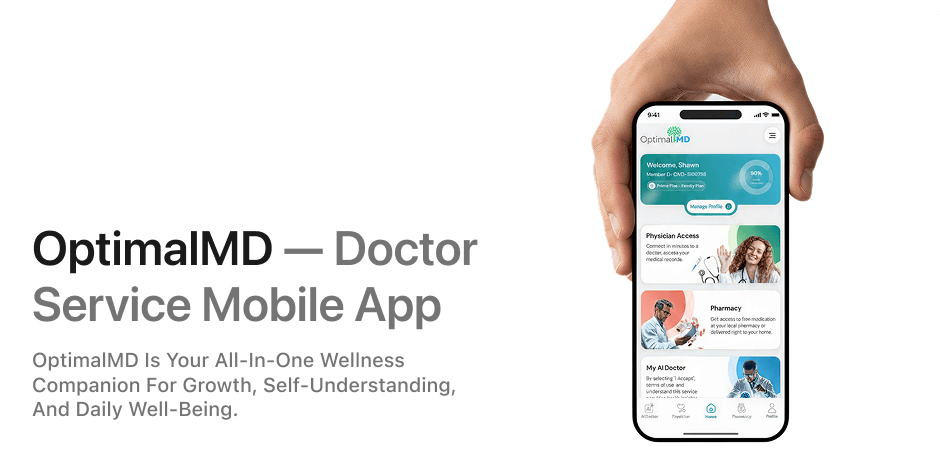
When we built OptimalMD's digital product end to end, from design through development to launch, it covered the website, the members portal and the mobile app. If you're scoping something similar, our apps and SaaS development team starts from the same questions in this article.
For a worked example of the same decision in one product category, our breakdown of remote patient monitoring software, build versus buy goes through it in detail.
A build order that avoids rework
Sequence matters more than speed in healthcare SaaS platform development, because the early decisions are the expensive ones to reverse.
- Decide your regulatory position: whether you're a business associate, and whether any planned feature makes the software a device.
- Map every place ePHI travels, including admin tools, hosting regions and each outside provider, and get the agreements in place.
- Model your data around FHIR resources before you design screens.
- Build the narrowest workflow that one kind of buyer would pay for, as we describe in our guide to a healthcare MVP that gets funded.
- Add incident records and a way to return or delete customer data before the first customer signs.
If your product includes video visits, read our list of telehealth platform features patients expect before step four, since it changes what "narrowest" means.
Frequently asked questions
Can a healthcare SaaS platform store patient data on servers outside the US?
HHS's cloud guidance allows it, as long as a BAA is in place and the other HIPAA requirements are met. Mintz's summary adds that you should weigh the higher hacking and malware risks of those locations, and that cross-border transfers can raise other regulatory issues.
Does a SaaS provider have to keep patient data after a customer leaves?
No. The guidance says providers need not retain ePHI after their services end, which is why return or deletion should be designed in rather than handled by hand.
Must a SaaS provider let customers audit its security?
HIPAA doesn't require a cloud provider to hand over its security documentation or allow customer audits. Customers still have to run their own risk analysis, so most will ask for the information anyway.
Do I need REST to use FHIR?
No. HL7's overview says you don't have to use REST to make use of resources. A Capability Statement describes the interfaces your implementation exposes for exchanging data.