














US digital health startups raised $7.4 billion across 244 deals in the first half of 2026, according to Rock Health's report published in July. That sounds like an open door, but healthcare MVP development is judged more harshly than a typical software build, because the first version has to be safe with patient data and credible to a buyer who has seen a hundred pitches.
This guide walks through what to prove, what to cut, and which compliance decisions can't wait until after launch.
What investors are funding in digital health
Rock Health's mid-2026 read is that investors now back founders who understand the buyer's problem, not founders who simply have AI. The report says AI has made tailored products easier to build but has also flooded buyers with options, which raises their expectations for measurable return.
Rock Health also points to partnerships that lend credibility and to strong customer support during rollout as things funders look for. For an early team, that translates into a plain brief: your MVP should show that you know one buyer's workflow well enough to improve it.
Capital is also concentrating. Deals of $100 million or more took 45% of all dollars in the half, while the median deal size rose to $14 million from $12 million in 2025. A seed-stage team isn't competing for those mega rounds, so name the part of the market you're pitching into and size your ask to it.
One more detail from the same report: mental health stayed the top-funded clinical indication for a seventh straight year, with weight management second. Crowded categories aren't closed ones, but you'll need a sharper wedge to stand out in them.
What healthcare MVP development should include
A fundable healthcare MVP covers one workflow for one type of user, from the first click to a result the buyer can measure. Everything else waits.
Pick the workflow by asking who signs the contract and what number they report upward. A clinic manager cares about missed appointments, a practice owner cares about collections, and a care team cares about minutes saved per patient. Build the smallest slice that moves that number.
Then cut ruthlessly. Patient messaging, analytics dashboards, multi-location support and a full admin console are all reasonable features, and all of them belong after the first pilot. Our breakdown of what a dental practice SaaS MVP costs shows how quickly each added module changes the budget, and the logic carries over to other clinical niches.
Integrations deserve a harder look than features. If your product only works once it's wired into an electronic health record, then the integration is the MVP, and you should plan the build around it.
Build, buy or integrate each piece
Not every component needs custom code. Video, messaging and scheduling can often come from a vendor that will sign a business associate agreement, leaving your engineers to build the part buyers can't get elsewhere.
We cover that trade-off for one product category in our remote patient monitoring build versus buy comparison. The same question applies to your MVP: which piece is your edge, and which piece is plumbing?
Settle your FDA position before you write code
Whether your software counts as a medical device decides your timeline, so answer it on day one. The test is intended use: software that diagnoses, treats or prevents disease is regulated differently from software that handles scheduling or admin work, as one compliance vendor's pre-launch checklist for healthcare MVPs puts it.
If your product supports clinical decisions, the FDA's clinical decision support software guidance is the document to read. It sets out which decision support functions are excluded from the device definition under the 21st Century Cures Act, and it gives examples of how the agency views different kinds of software functions.
Software that doesn't meet those non-device criteria stays subject to FDA oversight, including functions aimed at patients and caregivers. The practical consequence is that a feature description like "suggests a treatment" carries more regulatory weight than one saying "displays the patient's history", so word your product claims with care and have them reviewed by someone qualified before you publish them.
None of this means you should avoid clinical features. It means you decide deliberately, early, and keep the scope of the MVP inside the line you chose.
Handle patient data properly from the first commit
Three habits keep an early healthcare product out of trouble, and all of them are cheaper on day one than in month six.
- Map where patient data is created, stored and sent, before choosing infrastructure.
- Collect only the data your MVP hypothesis needs, and use de-identified data in development and testing.
- Log who accessed what and when, and put role-based access and multi-factor authentication in place from the start.
Those practices come from the same checklist, which also recommends field-level encryption for especially sensitive attributes and opt-in consent for sensitive processing.
Hosting is the other early decision. HHS guidance on cloud computing, as summarised by Health Data Management, says organizations need a business associate agreement with a cloud provider before storing or processing electronic patient health information there. Encryption alone doesn't cover the gap, because it doesn't protect the integrity and availability of the data.
The same summary lists what customers still owe once the contract is signed: incident response policies, current security assessments of vendors, and a check at contract end that the provider returns or destroys the data.
Plan for those obligations when you pick tools. A vendor that won't sign an agreement is off the list, however good its product looks.
How to design for clinicians and patients

Photo by Cedric Fauntleroy on Pexels
Clinical staff will abandon anything that adds clicks to a shift that's already full. Design the MVP around the three or four screens your pilot users will touch most, and test them with real staff before you build the rest.
That is where a strong UI/UX process earns its place in an MVP budget. Rebuilding a confusing patient intake flow after a pilot has begun costs you the pilot's goodwill as well as developer time.
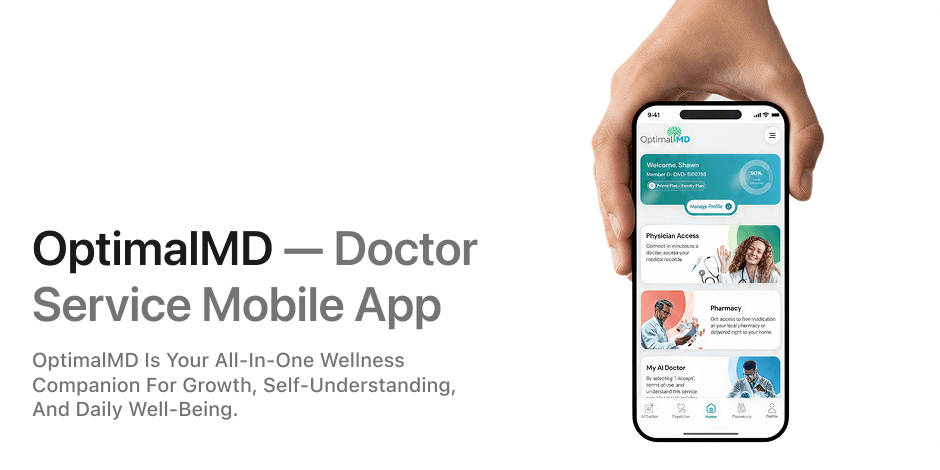
When we built OptimalMD's digital product, we handled the design, development and launch of the website, the members portal and the mobile app as one piece of work. Our OptimalMD case study shows how those three surfaces fit together.
Turn the MVP into a pitch investors believe
Funders can't evaluate an MVP they can't see in use, so aim for a live pilot with a named customer rather than a polished demo. Rock Health's emphasis on measurable return suggests the pilot should report one number the buyer already tracks.
Write that number down before the pilot starts, agree how it will be measured, and share the result when it lands. A small, honest result beats an impressive projection.
Partnerships help too, since Rock Health lists them as a credibility signal. A clinic that will act as a reference, or a platform vendor that will integrate with you, gives an investor something to verify.
Keep in mind how this fits the larger picture of your product. Our complete guide to healthcare software development covers what comes after the MVP, and our apps and SaaS team builds these first versions for founders who want one partner from design through launch.
Finally, set a stopping rule. Decide in advance what pilot result would justify raising money, and what result would send you back to rework the workflow. Founders who set that line early spend less on features nobody asked for.
Frequently asked questions
Do I need a business associate agreement with my hosting provider?
Yes, if the provider will store or process electronic patient health information for you. Per the HHS guidance as summarised by Health Data Management, that agreement must be in place first, and every other vendor handling patient data needs one too.
Is every healthcare app regulated as a medical device?
No. Some clinical decision support functions are excluded from the device definition, while software that doesn't meet the exclusion criteria remains regulated. Scheduling and similar administrative tools sit outside the definition, so your stated intended use is what decides.
Can I use real patient records while building the MVP?
You shouldn't need to. A compliance checklist for healthcare MVPs advises using de-identified datasets during development and collecting only the data your hypothesis requires.
Cover photo by Vitaly Gariev on Pexels
Sources
- Digital health funding in the first half of 2026 (Rock Health) — Healthcare Dive
- New guidance lays out HIPAA obligations for cloud computing — Health Data Management