














A 4.0-star rating used to be good enough to get the phone ringing. For three out of four patients searching for a new provider in 2026, it isn't anymore.
Patient acquisition marketing for healthcare practices now runs through review sites and AI search tools as often as it runs through a plain Google search. A practice that treats its online reputation as an afterthought is losing patients before anyone ever picks up the phone.
Why review sites decide who gets the first call
Medical Economics reported that a rater8 survey of patients searching for a new doctor found three out of four would not book with a provider rated below 4.0 stars. A good share held the line at 4.5 stars instead.
The same survey traced those ratings back to specific complaints, not vague dissatisfaction. Patients most often blamed:
- Staff who were rude or unhelpful, or a doctor who didn't listen, each cited by 52% of respondents
- Long wait times, cited by 41%
- Billing problems, cited by 40%
None of that is a marketing problem by itself. But every one of those complaints becomes a review a prospective patient reads before they ever call.
That makes front-desk training and clear billing part of patient acquisition, whether a practice budgets for them that way or not.
Responding to reviews moved the needle too. Trust in a provider's response jumped from 42% in 2025 to 66% in 2026, the sharpest year-over-year shift rater8 has tracked. Answering a bad review candidly, without getting defensive, is acquisition work, not just damage control.
AI tools are already part of how patients search
MediaPost reported that the share of patients who said an AI tool most influenced their choice of provider rose from 17% to 36% in a single year. That overtook both organic Google results and a physician's own referral.
Patients aren't always choosing AI search on purpose. Many run into it automatically, since Google now surfaces an AI Overview above the links it used to show first.
That shift in default behavior matters more than any single practice's marketing budget. MediaPost noted that patients now trust those AI summaries more than standard organic search results, by 37% to 20%.
Older patients, not younger ones, are leaning into this hardest, which runs counter to what most practices assume about who's searching with AI. That's a reason not to write off a channel just because a staff member's gut says patients "don't use that."
What patient acquisition marketing actually includes
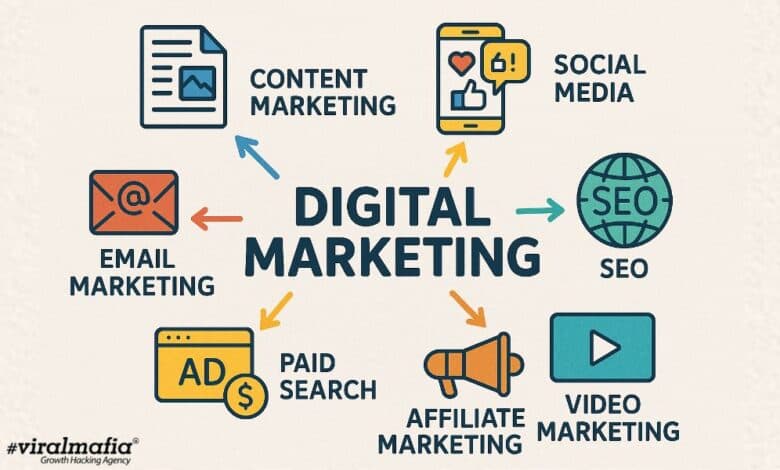
Patient acquisition marketing isn't one channel. It's the handful of channels a practice actually controls, run well enough that the reputation work above doesn't go to waste.
Local search and your Google Business Profile
Most new-patient searches start as a local search, not a trip to a brand's homepage. A complete, accurate Google Business Profile is the base layer: hours, insurance accepted, services offered, and a steady flow of recent reviews.
We've covered optimizing a healthcare Google Business Profile and healthcare local SEO in more depth, since both decide whether a practice even shows up before a patient starts comparing options.
Content that earns trust before the first call
Educational content, symptom explainers, procedure breakdowns, plain-language FAQs, works because it answers the questions a patient is already typing into a search bar or an AI chat window. It's slower than paid ads, and it keeps paying off instead of switching off the moment you stop paying for clicks.
Our healthcare content marketing guide covers how to build that out without it reading like a brochure.
Referrals and review management
Referral relationships with other providers still send patients who arrive already trusting the practice. Reviews do a version of the same job at scale, which is why the response-rate shift above matters more than most practices treat it.
Paid search and social ads
Paid campaigns are the fastest way to put a practice in front of a patient who's actively looking, and the only channel here with a true on/off switch. That makes them a reasonable way to fill a new location or a slow service line fast.
But a weak Google Business Profile or a page of 3-star reviews undercuts the ad spend before it gets a chance to work.
Follow-up for the patients who don't book right away
Most people who find a practice online don't call on their first visit to the website. They compare a couple of options, read a few more reviews, and decide later.
A short follow-up sequence, by email or text, for anyone who filled out a contact form but didn't book closes more of that gap than another dollar of ad spend usually does.
Mapping that decision path is also where a lot of practices realize they lose people between "asked a question" and "booked an appointment." Our piece on customer journey mapping walks through how to find that gap, even though it's framed around a dental practice.
Set a budget you can actually measure

Photo by Mikhail Nilov on Pexels
The Society for Health Care Strategy & Market Development, the marketing arm of the American Hospital Association, runs the industry's main benchmarking survey for healthcare marketing budgets and staffing.
It added a dedicated AI adoption panel for its 2025-2026 edition, which says something on its own: marketing leaders are now expected to show what their AI spend is doing, not just their ad spend.
You don't need a hospital system's budget to apply the same discipline. Decide what a new patient is worth to the practice over their full relationship, not just their first visit, and work backward from that to what you're willing to spend acquiring one.
SHSMD's benchmarking exists because new patient acquisition is treated as a formal, trackable metric at the enterprise level. A single-location practice can track the same thing with a spreadsheet: source, cost, and whether the patient actually showed up.
That's also where a managed digital marketing and growth engagement earns its keep: tying ad spend, SEO, and review management to an actual per-patient number, instead of running each channel in isolation and guessing at the overlap.
Keep compliance in view, not as an afterthought
Healthcare marketing carries obligations most consumer marketing doesn't. What a practice can say about a patient's condition is one example.
How it handles patient data in forms and chat widgets, and what it can promise in an ad, are also governed by rules that don't apply to a retail business running the same playbook.
We cover the specifics in what HIPAA-compliant marketing actually allows, and it's worth reading before a campaign goes live, not after a complaint does. Build that review into the plan from the start. It's cheaper than retrofitting a campaign that already ran.
Frequently asked questions
Is patient acquisition marketing different from patient retention marketing?
Yes. Acquisition is about getting a new patient to book a first appointment; retention is about getting them to come back and refer others.
They share channels, since reviews and content work for both. But a practice with high turnover often has a retention problem that no amount of acquisition spend will fix.
Do online reviews really decide whether someone books?
For most patients, yes. Three out of four won't book below a 4.0-star rating, and that threshold has only gotten stricter over the past two years, not looser.
Should a small practice worry about AI search tools like ChatGPT or Google's AI Overviews?
Yes, and sooner than most expect. More patients are turning to AI tools to research providers each year, and many land there without choosing to, simply because Google now shows an AI summary before its usual search results.
Can referrals and reviews carry most of the load instead of paid ads?
For an established practice with a strong reputation, often yes. Paid ads are better suited to filling a new location or a slow service line quickly, where waiting for referrals and reviews to compound isn't an option.
How is new patient acquisition usually measured?
By tracking where each new patient came from, what it cost to acquire them, and whether they actually showed up, not just how many clicks or calls a campaign generated.
Cover photo by RDNE Stock project on Pexels