















Most of the administrative cost in a clinic hides in tasks too small to notice one at a time. A reminder call, an eligibility check, a referral chased by phone: each takes minutes, and together they fill the working week. Healthcare workflow automation software takes over the repeatable ones, and the case for it is clearest in prior authorization.
In the American Medical Association's 2024 prior authorization survey of 1,000 physicians, as reported by Medical Economics, practices spent 13 hours of combined physician and staff time each week on it. Forty percent of those physicians employed staff who did nothing else.
What healthcare workflow automation software actually does
It runs routine administrative, operational and financial tasks with little manual effort, following rules you set. A patient books online, the system checks eligibility, sends the intake form, and reminds them the day before. Nobody at the front desk touches it unless something fails.
That last clause matters. Canvas Medical, an EHR vendor, makes the point in its June 2026 guide to workflow automation that every automated process needs an exception path: a named person who handles it when the rule can't.
Automation, then, is a way of deciding which work reaches a human and which doesn't. Software that skips that decision just moves the pile from one desk to another.
Which workflows to automate first
Start with work that happens often, follows clear rules and has a predictable outcome. Canvas Medical's guidance is that appointment reminders, intake forms, eligibility checks, task routing and follow-up reminders make better first projects than complex clinical workflows.
The candidates it lists fall into two groups:
- Operational: patient intake and registration, appointment scheduling and reminders, referral tracking, and outreach for preventive-care gaps.
- Financial: insurance eligibility verification, claims preparation and validation, denial routing, and payment reminders.
If you can only pick one, pick the task your front desk complains about most. A visible win in the first month earns the patience you'll need for the harder workflows later.
Our own list of healthcare AI automation ideas goes further down that road once the basics are running.
Why prior authorization still needs a person
Much of prior authorization can be automated operationally, such as pulling the chart, attaching documentation and submitting the request. Judgement calls can't be. Canvas Medical says human review stays important where medical necessity is ambiguous, documentation is missing, or the case involves appeals, payer exceptions or peer-to-peer review.
Physicians Practice, in a February 2026 article on AI in the medical practice, reports that early adopters of AI-driven prior authorization are seeing first-pass approval rates above 90%. Treat that as what adopters report rather than a benchmark for your practice, since the article doesn't say how those practices were chosen.
The practical design is a split. Automation prepares and submits the straightforward requests, and your staff keep the denials and appeals, where their time is better spent anyway.
Where the savings come from
The biggest savings come from replacing manual and paper handling of transactions that already have an electronic form. The CAQH Index, which tracks how far payers and providers have automated, estimated in its 2022 edition that the industry could save nearly $25 billion, or 41 percent, by moving to fully electronic transactions. That report was published in January 2023, so the dollar figures are dated, but the pattern in it still holds.
Adoption was uneven. Automation was highest for acknowledgements and claim submissions, and attachments were the weakest area for the medical industry at 24% electronic adoption.
We couldn't find a trustworthy per-practice cost range in the sources we read, so we won't quote one. Budget from your own volumes: count how many times a week your staff repeat a task, and multiply by the minutes it takes.
Connecting automation to your EHR
An automation that can't read from and write back to your EHR creates a second place to keep patient data, and staff will end up reconciling the two. Canvas Medical argues that automation built into the EMR responds to real-time clinical events without added latency or duplicated logic, and that external tools are weaker for that reason. It sells an EHR, so weigh the argument with that in mind, but the underlying problem is real.
Whichever route you take, ask where the data lives after each step, who can see it, and what happens when the two systems disagree.
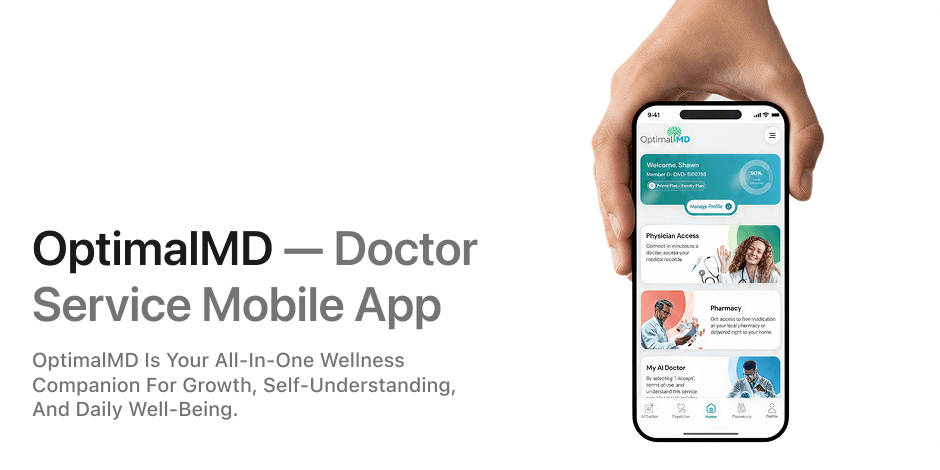
When we designed and built OptimalMD's website, members portal and mobile app end to end, from design through launch, the three had to work as one product. The OptimalMD case study shows how that came together.
If the integration itself is the hard part, our write-up on EHR software development and compliance covers what the build involves.
Vetting vendors for HIPAA and data use

Get a signed business associate agreement before any patient data reaches the tool. Physicians Practice advises administrators to insist on one, to confirm in writing that the vendor won't use patient data to train its models without authorization, and to require short breach-notification timelines.
The same article notes that the HHS Office for Civil Rights proposed updating the HIPAA Security Rule in January 2025 to require AI tools to be included in risk analyses. A proposal isn't a rule, so check where it stands before you rely on it, but including automation tools in your risk analysis now costs little.
For the build side of this, what HIPAA-compliant app development takes goes through the technical safeguards.
Checking AI output before it reaches a patient
Rule-based automation fails loudly, since a reminder either sends or it doesn't. AI-generated output fails quietly, which is the greater danger.
Physicians Practice describes ambient scribes that insert symptoms or diagnoses that don't match what happened in the room, and notes that clinicians must review AI-generated notes before signing. Its shorthand is "set it, but check it."
Build that review into the workflow rather than leaving it to good intentions. Someone should own the sign-off, and the system should make it hard to skip.
Rolling it out without breaking the front desk
Automate one workflow, run it beside the manual process for a few weeks, and compare. Count the exceptions it throws and who resolved them. If the exception queue is longer than the time the automation saved, fix the rule before adding another workflow.
Then write down who owns each exception path, what the staff do when the system is down, and which reports prove it's working. Only after that is it worth moving to the second workflow.
Our AI and automation work follows the same order: one measurable process, a named owner for failures, then the next.
Frequently asked questions
Which workflow should a clinic automate first?
Pick a frequent, rule-based task such as appointment reminders, intake forms or eligibility checks. Canvas Medical recommends these over complex clinical workflows as first projects.
Can automation fully handle prior authorization?
Not entirely. The routine submission work can be automated, but human review remains important for ambiguous medical necessity, missing documentation, appeals and peer-to-peer reviews.
Do I need a business associate agreement with an automation vendor?
If the tool touches patient data, Physicians Practice advises insisting on a signed one, along with written confirmation that your data won't train the vendor's models without authorization.
Does workflow automation work with my existing EHR?
It depends on the integration. Ask any vendor how the tool reads from and writes back to your EHR, since a tool that only reads leaves staff re-entering data by hand.
Cover photo by Tima Miroshnichenko on Pexels