
















Critical access hospitals nearly tripled their use of core clinical data analytics between 2014 and 2023, growing from 21% adoption to 56%, while larger hospitals reached 69% that year, according to a 2023 American Hospital Association survey published in JAMIA.
A healthcare data analytics platform used to be something only the biggest systems could justify. That's no longer true.
Federal rules now force the issue too. Large payers must expose standardized data through FHIR APIs, and hospitals connected to those pipelines find it easier to turn claims, scheduling and clinical notes into something a care team can act on.
This guide covers what these platforms do, why the rules shaping them are tightening, and what's worth getting right before committing budget to one.
What a healthcare data analytics platform actually does
A healthcare data analytics platform pulls data out of the systems that already hold it, the EHR, billing, scheduling, a lab interface, and lands it somewhere unified enough to query across all of them.
None of those source systems is built, on its own, to compare a patient's visit history against a disease registry or flag who's falling behind on screenings.
Most platforms solve that through a data warehouse or lakehouse layer, then add a reporting or dashboard layer so clinical and operational staff aren't writing queries themselves.
The better ones also expose that same data through APIs, so other tools, a patient portal, a population health program, a scheduling app, read from one source instead of each keeping its own copy.
Why adoption is accelerating right now
Adoption is accelerating because predictive tools that used to be experimental are now routine.
By 2023, using algorithms to flag high-risk patients for follow-up care had become standard practice at most hospitals, regardless of size: 85% of non-critical access hospitals and 73% of critical access hospitals were already doing it, per the same AHA survey.
Money matters here too. Catching claim denials before they happen, or spotting where a billing workflow is bleeding cash, is one of the most mature analytics use cases in a hospital.
It's often the first one a finance team pushes for. Anyone building or shopping for this kind of system should look at how medical billing software gets built before assuming an analytics layer can bolt onto whatever billing system is already in place.
The interoperability rules reshaping these platforms
A federal rule is the most concrete reason these platforms now need to speak FHIR instead of just storing data well.
CMS's interoperability and prior authorization rule, finalized as CMS-0057-F, requires Medicare Advantage plans, state Medicaid and CHIP programs, Medicaid managed care plans and qualified health plan issuers to expose patient, provider and prior authorization data through FHIR APIs.
The rule's own fact sheet sets two deadlines: operational provisions and prior authorization metrics reporting start January 1, 2026, and the full API build-out, covering Patient Access, Provider Access, Payer-to-Payer and Prior Authorization APIs, must be finished by January 1, 2027.
The rule names exact standard versions rather than FHIR in the abstract:
| Standard | What it covers |
|---|---|
| HL7 FHIR Release 4.0.1 | Base format for exchanging patient records through an API |
| US Core STU 3.1.1 | Minimum data elements every FHIR API must expose |
| SMART App Launch 1.0.0 | How a third-party app authenticates before it can pull that data |
| FHIR Bulk Data Access | Exports whole patient populations at once instead of one record at a time |
A platform that can't ingest and export in these formats will need custom integration work for every payer and provider it talks to, and that cost compounds every time a partner changes systems.
Where predictive analytics actually fits
Predictive analytics fits where descriptive reporting stops: telling you who's likely to need help before the visit that reveals it.
Most of what a hospital calls analytics today is still descriptive, dashboards, last month's volumes, a readmission count.
Mordor Intelligence's 2026 research puts descriptive analytics at 45.87% of the healthcare analytics market in 2025, the largest single slice, while predictive analytics is growing faster than any other category, at a 24.65% compound annual rate.
A dashboard tells you what already happened. The predictive layer flips that: using the same high-risk-flagging approach already common at most hospitals, it tells you who's about to need help before the visit that triggers it.
A predictive layer is only as good as the descriptive foundation underneath it. That's why hospitals that skip straight to AI often find the model has nothing clean to learn from.
Population health programs are where this shows up most concretely: flagging a diabetic patient who's missed two follow-ups, or a post-surgical patient whose vitals are trending the wrong way.
We've written up a broader set of healthcare AI automation ideas worth borrowing even if a full predictive platform isn't in this year's budget.
Connecting clean data to a model that changes a workflow is close to the work our AI & automation team does for clients outside healthcare too, just with stricter rules attached.
Get the foundation right before you build or buy
Getting the foundation right starts with one question: who owns data quality once the platform is live?
A dashboard built on duplicate patient records or stale scheduling data produces confident-looking numbers that are wrong, and nobody downstream will know it.
Decide what "done" looks like for the first use case, not the whole roadmap.
A platform that reliably flags no-shows for one department before it tries to run population health for an entire hospital earns trust it can spend later. Trying to ship everything in the first release is how these projects stall.
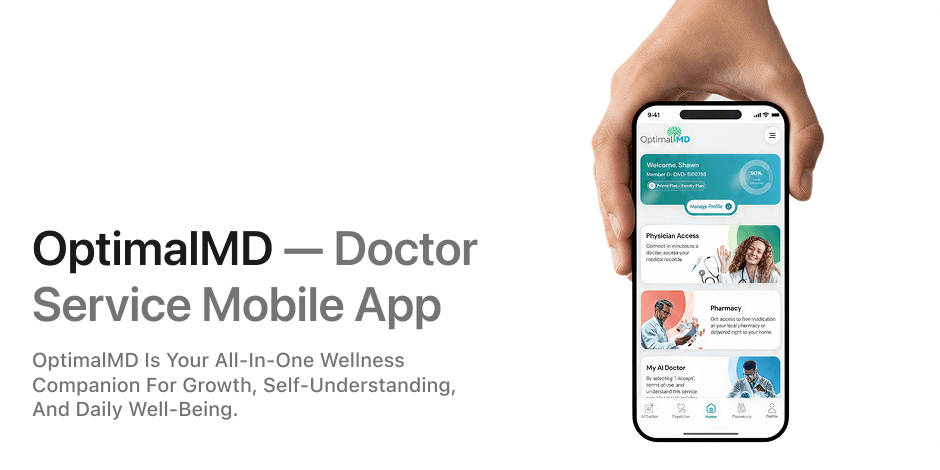
We've built this kind of foundation before. We designed and built OptimalMD's digital product end to end, the website, the members portal and the mobile app.
In any multi-surface build like that, the data layer only works if it has one home instead of three. That's the same discipline a data analytics platform needs, whether it's custom-built or bought off the shelf.
If a custom build is on the table, our apps and SaaS team can walk through what that scoping actually looks like, and the OptimalMD case study shows how that project came together.
Frequently asked questions
Does a healthcare data analytics platform replace the EHR?
No. It sits alongside the EHR and other systems, pulling data out through FHIR APIs or batch exports rather than replacing any of them. The EHR stays the record for a single encounter; the analytics platform is where data from many encounters gets compared.
Do small or rural hospitals need one, or is this only for large health systems?
The gap is real but closing fast. Critical access hospitals went from 21% to 56% adoption of core clinical analytics between 2014 and 2023, compared to 69% at larger hospitals in 2023. Size no longer rules it out; budget and staff time still do.
Is my hospital legally required to have a FHIR-based analytics platform?
The federal mandate falls on payers, not providers. That same rule requires Medicare Advantage plans, state Medicaid and CHIP programs and qualified health plan issuers to build FHIR APIs by January 1, 2027.
A hospital isn't named in that rule, but it still needs matching FHIR standards to exchange data smoothly with those payers.
What's the real difference between descriptive and predictive analytics here?
Descriptive analytics reports on what already happened, last month's readmissions, current bed occupancy. Predictive analytics uses that same data to flag what's likely to happen next, like which patient is at risk of missing a follow-up. Descriptive still leads the market, but predictive is its fastest-growing slice.
Sources
- CMS Interoperability and Prior Authorization Final Rule CMS-0057-F — CMS
- Trending in the right direction: critical access hospitals increased adoption of advanced electronic health record functions from 2018 to 2023 — Journal of the American Medical Informatics Association