















Providers reported 804 large data breaches in 2025, and hacking or other IT incidents caused the large majority of them, according to HIPAA Journal's ongoing tracking of the federal breach database.
Choosing a healthcare app development company is largely a decision about which vendor you're trusting not to be the next name on that list.
A slick portfolio and a fast quote don't tell you whether a team actually understands what protected health information requires. By the time you find out, the app is already built.
This guide walks through what actually separates a company built for healthcare work from a generalist studio that added "HIPAA compliant" to its site last month. The paperwork they'll sign, the safeguards they can explain in plain language, and the questions worth asking before any contract goes out.
What a healthcare app development company should prove before you sign
Ask to see apps a vendor has actually shipped in healthcare, not a slide with client logos on it. A studio that mostly builds retail sites and marketing pages can write clean code.
But it hasn't had to think through what happens when a patient's lab result sits in a database that a third-party analytics tool can also read.
Look for a team that can walk you through its safeguards without reaching for a script. If the answer to "how do you handle PHI in transit" is a shrug or a generic security page, keep looking, no matter how polished the pitch deck is.
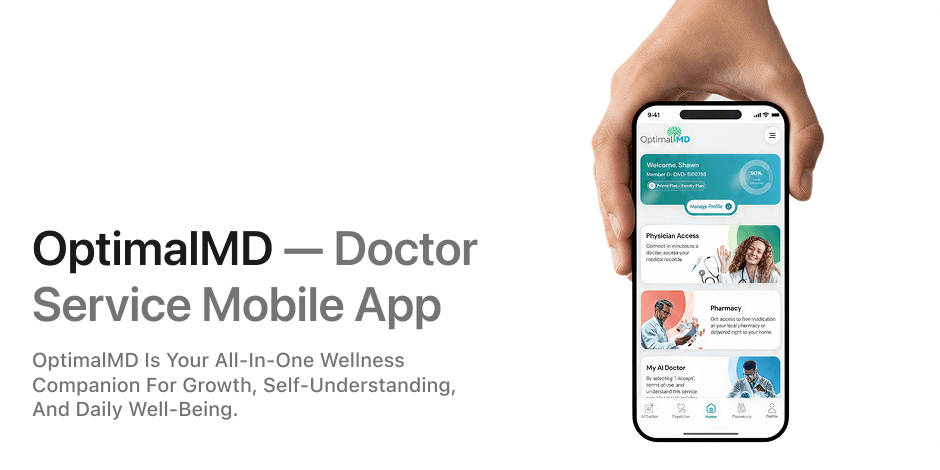
When we built OptimalMD's digital product, we designed and developed the website, the members portal and the mobile app end to end, from design through development to launch.
That's the kind of full-stack healthcare build worth asking a vendor to point to: not a single module, but a working product patients and staff actually use every day.
A vendor's case studies should hold up to a direct question, too. Ask which of their own people worked on the project and whether those same people are available for yours.
A proposal that names specific engineers commits to something a slide of stock team photos never does.
What HIPAA actually requires from whoever builds it
If your app creates, stores or transmits protected health information on your behalf, the company building it is legally a business associate under HIPAA, not just a contractor. That status comes with paperwork most generalist agencies have never signed.
Federal guidance on business associates requires a written contract before a developer can touch electronic PHI at all.
It has to spell out exactly what the vendor may do with the data, require them to build in the Security Rule's safeguards, and obligate them to report a security incident back to you, including anything that turns into a breach of unsecured PHI.
That contract is the Business Associate Agreement. A vendor that hesitates to sign one, or wants to water down what it covers, is telling you something about how seriously it takes the rest of the build.
The Security Rule itself sets out administrative, physical and technical safeguards. In practice, that means a documented risk analysis, role-based access so staff only see what their job requires, audit trails on who touched PHI and when, and a process for identifying and documenting security incidents as they happen.
Ask a prospective vendor to walk through each of those in the context of your specific app, not as a checklist item buried in a proposal. We've written a separate technical walkthrough of what HIPAA compliant app development actually takes if you want the engineering-level detail behind this section.
What a compliance shortcut actually costs
Providers reported 804 large data breaches in 2025, the highest count HIPAA Journal has tracked since federal reporting began.
Hacking or other IT incidents caused the large majority of them, not lost laptops or paperwork left in a car.
The scale of individual incidents matters more than the headline count. A single 2025 breach at Conduent Business Services exposed 62.2 million records on its own, the kind of number that turns a software vendor's mistake into a client's multi-year cleanup.
A development partner who treats encryption, access logging and vendor risk assessments as optional line items isn't saving you money. They're deferring a cost that shows up later as breach notification letters, regulatory scrutiny and a rebuild of whatever got cut the first time.
Making sure the app can actually talk to your EHR
Ask early whether the app needs to pull data from, or push data into, your electronic health record. This is where a lot of healthcare software projects quietly stall: a beautifully built app that can't see the patient records it was supposed to work alongside.
Certified EHR systems are required to expose open, FHIR-based APIs under federal interoperability rules, so a competent developer should be building against a real published standard rather than reverse-engineering a proprietary export.
Under those rules, a new app has to be verified within 10 business days and registered for production use within 5, not months of back-and-forth with an EHR vendor's support desk. Patients authorize third-party access the same way they'd log into any other app, through OAuth.
If your vendor can't explain how their build handles FHIR resources, or hasn't dealt with an EHR vendor's registration process before, that's a real gap, not a minor detail to sort out later. We cover the broader interoperability landscape in our complete guide to healthcare software development.
The same logic applies to patient-facing tools specifically. A patient portal lives or dies on whether it can pull accurate, current records without a staff member re-entering data by hand.
In-house build or specialized partner: what actually decides it

Some health systems do have the internal engineering bench to build and maintain a compliant app themselves. Most don't, because that team is already stretched across the EHR, the network and every other piece of infrastructure that has to keep running today, not in six months.
A specialized app development partner brings something your internal team usually can't: pattern recognition from having solved the same compliance and integration problems on other healthcare builds. That's the value you're actually buying, not just extra hands on a project plan.
The trade-off is real, though. An outside partner has to get up to speed on your specific workflows and constraints, and that ramp-up takes longer than handing the work to someone who already sits in your building.
Weigh that against how much runway your internal team actually has before you decide.
Questions to ask before you sign
A vendor's answers to a short set of direct questions tell you more than any proposal document. Ask these on the first or second call, before a contract is anywhere near the table.
- Who signs the Business Associate Agreement, and can we see your standard version before we're under contract?
- Which of your past healthcare projects can we speak to a client about directly?
- How do you handle encryption for data at rest and in transit, in plain language?
- Have you integrated with an EHR before, and which one?
- Who on your team will actually write the code, and are they available for the full build?
A vendor that answers all five without reaching for marketing language has probably done this work before. One that gets vague on any of them, especially the BAA question, is worth walking away from regardless of price.
Frequently asked questions
Does every healthcare app need to be HIPAA compliant?
Only if it creates, stores or transmits protected health information on behalf of a covered entity or another business associate. A general wellness app that never touches PHI doesn't trigger HIPAA, but most apps built for a provider, payer or health system do.
What's a Business Associate Agreement, and does our vendor need one?
It's the written contract HIPAA requires before a vendor can touch electronic PHI at all, spelling out what they can do with the data and holding them to the Security Rule's safeguards. If your app handles PHI, your developer needs to sign one before development starts, not after.
Will a new app connect to our existing EHR without a separate integration project?
It depends on your EHR vendor's certification, but certified systems are required to expose FHIR-based APIs under federal interoperability rules. A competent developer should be able to build against that published standard rather than starting from scratch.
How bad are healthcare data breaches, really?
Providers reported 804 large breaches in 2025 alone, and a single incident can expose tens of millions of records. The cost of getting security wrong dwarfs whatever a compliant build costs upfront.
Cover photo by Marek Prášil on Pexels
Sources
- Business Associates | HHS.gov — HHS.gov
- Healthcare Data Breach Statistics – Updated for 2026 — HIPAA Journal